Anawana Haloba
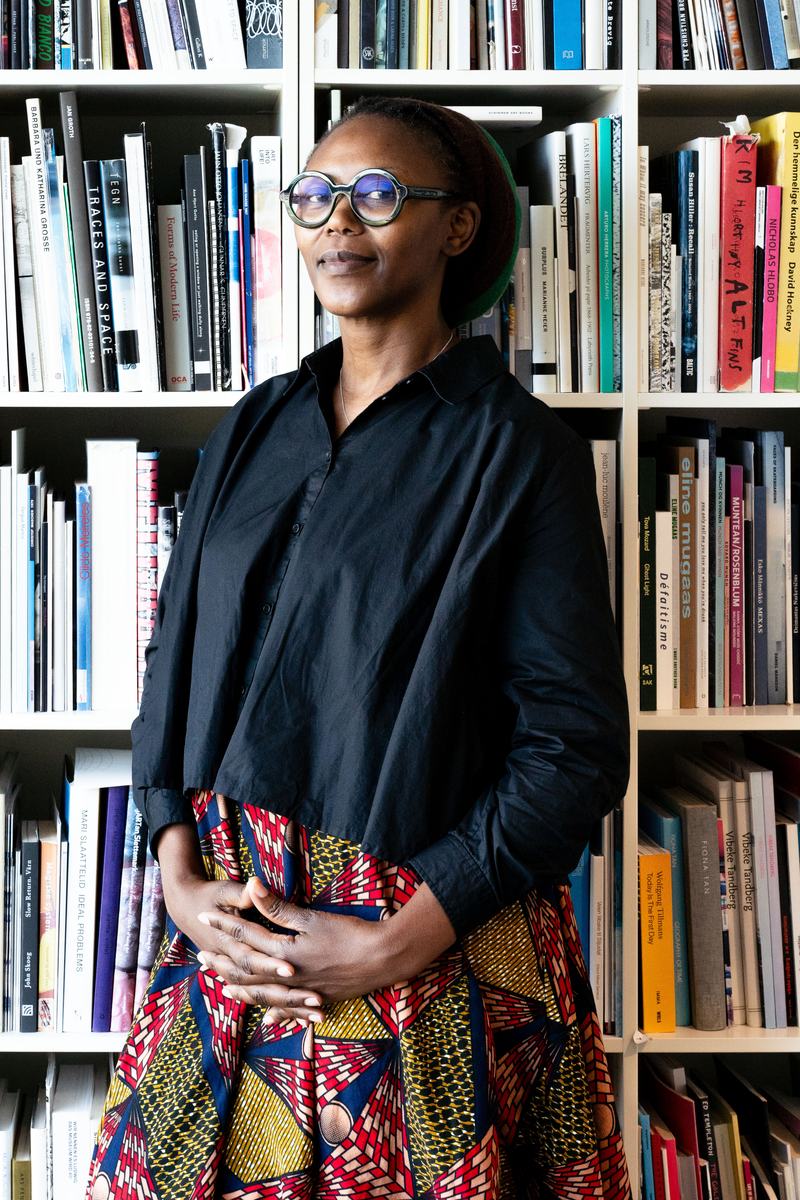
Anawana Haloba, Artist, Livingstone Office for Contemporary Art (LoCA), Livingstone, Zambia.
From aPlace We Eat From (portals and corridors)
Drawing from my notion of (Re)Pair as both an act and an ethic, this talk considers emotional infrastructure from the position of the Livingstone Office for Contemporary Art (LoCA), an artist-initiated organization I co-founded in Livingstone, Zambia. Although I do not work in a museum, the experiences and frameworks developed at LoCA offer a position from which museum professionals may reconsider how care, collaboration, and shared authority operate within their institutions. LoCA is a small library, research center, and experimental think-tank through which some of the curiosities and philosophies emerging from my artistic practice are tested within the context of community. It operates through a non-hierarchical model of sharing knowledge among artists, curators, writers, scholars, cultural custodians, students, neighbors, and audiences.
I use the ideas of portals and corridors to ask how cultural work can keep passages open: between people and institutions, oral and written knowledge, inherited histories and present urgencies, and audiences and workers. I also ask what remains at the beginning or end of a corridor, or on the other side of a portal. A corridor may be limitless or circular; its beginning and end continuously shift. It therefore makes us attentive to our positions within the passage and to the different urgencies those positions carry. A portal may be a song, an anecdote, an object, a remembered fragment, or an invitation. A corridor is the relation that allows it to travel. Drawing from LoCA’s workshops, mini-labs, screenings, publications, studio programs, and the Mosi-oa-Tunya Perennial, I propose care not as hospitality added after a program is made, but as a method through which knowledge is produced, authority is redistributed, and an ecosystem is sustained.
In places where passages have been fractured by coloniality, conflict, exile, underfunding, or institutional hierarchy, emotional infrastructure involves trust as an economy and the patient labor of reopening relation. It does not promise repair as a return to an intact past or consensus. Rather, it acknowledges damage and asks what new, integrated whole may be built through listening, dialogue, memory, material, translation, and mutual recognition.
Biography:
Anawana Haloba was born in Livingstone, Zambia, and lives and works in Oslo and Livingstone. She studied at Evelyn Hone College of Applied Arts, Lusaka, Zambia, and completed her BA at the National Academy of the Arts, Oslo in 2006. She is a graduate of the Rijksakademie van Beeldende Kunsten, Amsterdam, the Netherlands, and an alumna of the Smithsonian Artist Research Fellowship, Washington, DC. She is currently completing her PhD at the University of Bergen.
Her artistic practice is an ongoing investigation into the positions of different societies within varied political, social, economic, and cultural contexts, as well as ideological and post-independence frameworks. Her practice is symbiotically linked to her preparatory exercises in drafting poetry in the form of sketches, from which she abstracts performative-based artworks across moving image, installation, and sound. Through these works, she creates situations in which the material culture of a given place can be probed and reconsidered within rapidly shifting contemporary subjectivities.
Her work has featured in both solo and group exhibitions, including Centre Pompidou, Paris, France; PalaisPopulaire, Berlin, Germany; the National Museum for Contemporary Art, Trondheim, Norway; Oslo Kunstforening, Norway; GAMeC, Bergamo, Italy; SKMU Sørlandets Kunstmuseum, Kristiansand, Norway; the National Museum of African Art, Smithsonian Institution, Washington, DC, USA; Rauma Biennale, Finland; ZKM Museum of Contemporary Art, Karlsruhe, Germany; Museum Berardo Collection, Lisbon, Portugal; and KODE Museum, Bergen, Norway.
Her work has also been presented in numerous international biennials, including the Dakar Biennale, 2006; CAPE 07, 2007; Venice Biennale, 2009; Sydney Biennale, 2008, Australia; Manifesta 7, Bolzano, Italy; the Sharjah Biennial 08, 11 and 14, Sharjah, UAE; São Paulo Biennial, 2016; Shanghai Biennale, 2016; Lyon Biennale, 2017; Bucharest Biennial, 2021; Fellbach Triennial, 2022; Momentum 12, 2023; LIAF, 2024; and the Berlin Biennale, 2025.
She is Associate Professor of Contemporary Art, with a specialization in decolonial theory in artistic practice, at the Oslo National Academy of the Arts. She is also an advisor at the Rijksakademie van Beeldende Kunsten, Amsterdam, the Netherlands. Since 2014, she has co-founded and run the Livingstone Office for Contemporary Arts (LoCA), an artist-initiated non-profit library and research center, collective and collaborative platform, and experimental think tank. LoCA explores colonial and political histories and their legacies, and how these relate to language and contemporary art.