"The Word for World is Water"
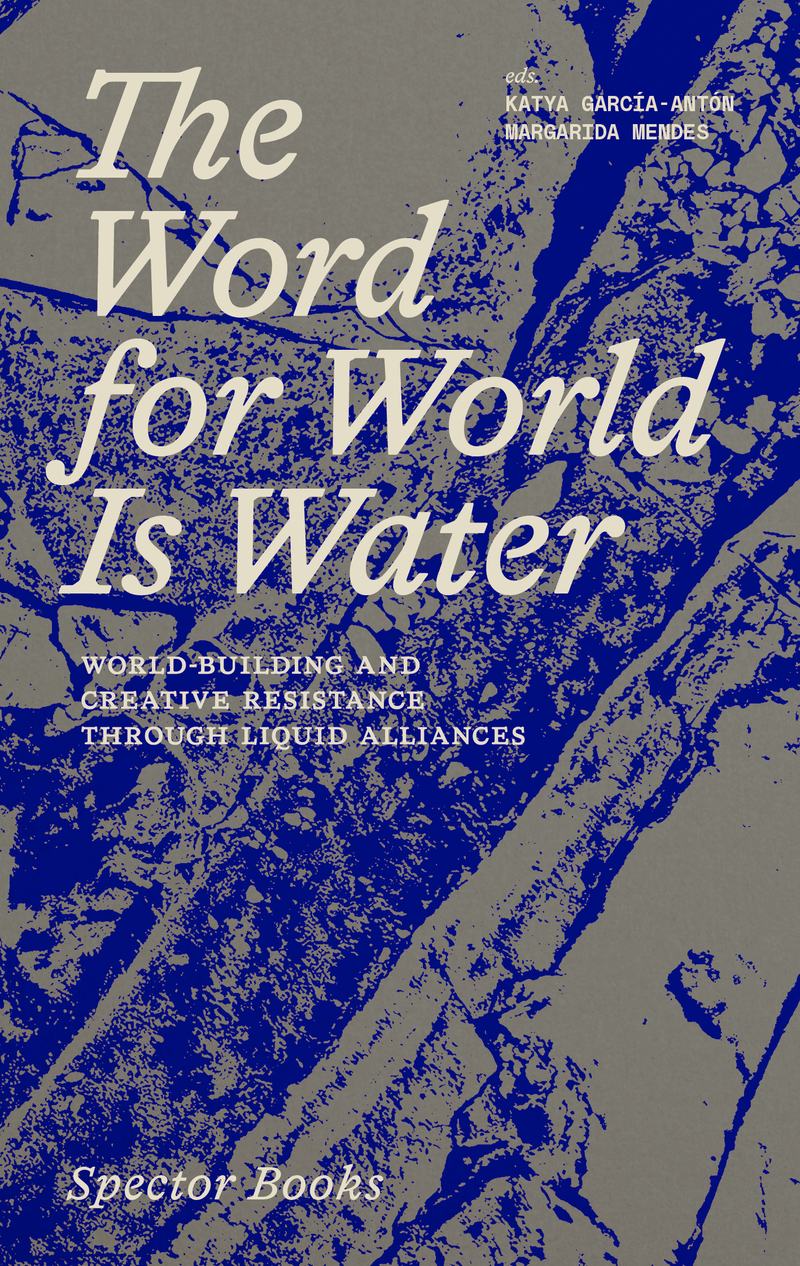
The Word for World is Water. World Building and Creative Resistance through Liquid Alliances unfolds as a choral constellation of voices—artists, researchers, and poets—who, from different geographies and through diverse bodies of water, propose a way of thinking about the world through relation, memory, and fluidity. More than a subject, water emerges here as a method: a way of knowing, relating, and imagining possible futures.
We speak with its editors, Katya García-Antón and Margarida Mendes, to explore the concepts that shape this publication.
Katya, Margarida, your practice sits at the intersection of ecology, spirituality, critical thought, Indigenous knowledge systems, and decolonial methodologies. What led you to conceive this anthology and to position water as a conceptual axis through which to think the world?
This anthology emerged from an invitation from ARCO Madrid, who gave us carte blanche to produce a book closing their sequence of water-related curated projects, previously unfolding between 2023-25. We both met at Sharjah Biennale 2025, and upon our gathering, political and methodological affinities clearly traced our journey towards this future collaboration. When we envisioned this publication we were extremely interested in the work of research-based artists, curators, poets and activists, who have dedicated their practice to water advocacy throughout the years, developing artistic projects, activist campaigns, fieldwork or collaborative and research-based curatorial projects focused around hydrologies. Shedding light on the interscalarity of water, expanding from locality, towards the planetary, their practice allows for an enhanced understanding about environmental rights across ecological dimensions, stretching from the body to the planet, reconfiguring worldviews and ideas about liminal politics. It seemed to us that water, being one of the most critical elements sustaining planetary life, allowed for intersectional conversations around ecological politics and artistic methodologies today, while exposing key topics on planetary governance.
The book unfolds as a polyphony of situated contributions. How did you select the contributors and their proposals? What kinds of relationships, tensions, or resonances were you seeking to establish between the different voices and geographies?
The Word for the World is Water - World Building and Creative Resistance through Liquid Alliances, maps out different water cosmologies and stories of territorial insurgency, by gathering voices of various authors across distinct bodies of water. Allowing for different modes of articulation, be they investigative essays, poetic reportage, fieldwork diaries, visual poetry, ritual scores, or annotated drawings, The Word for World is Water, serves as a register for some of these aquatic nodes to converge. Our desire was to address different parts of the hydrocycle – from the icy rivers in Canada, the peat bogs in the Northern Baltic, the wetlands of Goa, or the frozen mountainscapes of Himalayas – where different geographical inhabitations are invoked. These are often portrayed as ecotones, where modes of watery co-existence develop in enmeshed ways. Each contributor in the book presents a different water body and together they form a polyphonic hydrology: a chorus of aquatic thinking, remembrance, and resistance, depicting the frictions of each territory.
The book proposes water not so much as an object of study, but as a method: a way of thinking, relating, and imagining the future. How do you understand this idea of “thinking from water,” and what does it mean to adopt such a perspective in the art museum world?
Our enquiry on watery contexts emerged over the last decades, be it through Margarida’s ongoing curatorial and artistic research into environmental justice in toxic riverine landscapes, or through Katya’s dedication as a curator to the Indigenous webs of relations on icy landscapes (and her previous life as a biologist doing research in the Amazon and Sierra Leone). Recently the world has woken up to water-related artistic practices, not only due to the intensification of climate change, but also given the groundbreaking work of scholar Astrida Neimanis who opened new paths towards hydrofeminist practices, transforming experimental artistic methodologies. The duty of cultivating more conscious environmental subjects is shaping contemporary artistic practices diligently, and shaping museums’ ethos today. Necessarily this involves delving into contemporary artistic research methods and societal concerns, without neglecting the situatedness of communities, the living conditions and conflicts that involve them, let alone the global processes of interdependence that shape their existence. In acknowledging that water teaches us to talk about questions from a scalar perspective, we allow for its interconnectedness to mould the way we narrate contemporary relations.
Ailton Krenak frames water as a form of knowledge, as relation, and as a continuity between the human and the more-than-human. At the same time, he introduces the concept of fluid intelligence—adaptive, cyclical, and non-linear. How does this mode of thinking offer an alternative to more rigid or hierarchical forms of knowledge?
Along similar lines, Krenak insists on understanding water as a subject—as kin, ancestor, or teacher—rather than as a resource. What conceptual shifts are implied in moving from an extractive logic to a relational one?
Ailton Krenak understands water as subject—kin, ancestor, and teacher—while advancing “fluid intelligence” as a mode of knowing rooted in rivers as living, relational beings that connect human and more-than-human worlds. In this framework, knowledge does not stand apart from life as an abstract system to be mastered, but emerges through practices of listening, movement, and immersion—what he evokes as a kind of “we-river,” where subject and environment are co-constitutive rather than separate. Thinking with water entails attunement to flow, to seasonal rhythms, to erosion and renewal; it foregrounds forms of attention that are patient, situated, and responsive rather than extractive or classificatory.
Fluid intelligence, in this sense, privileges cyclical time, reciprocity, and transformation. It resists the linearity and fixity that often structure dominant epistemologies, where knowledge is stabilized, accumulated, and hierarchized. Instead, it proposes a mode of understanding that is adaptive and processual, capable of holding contradiction and change without resolving them into static categories. This has implications not only for how knowledge is produced, but for how it is shared and inhabited: it emphasizes interdependence over autonomy, and responsibility over control.
As an alternative to rigid or hierarchical forms of knowledge, Krenak’s thinking displaces the authority of detached observation and universal claims, replacing them with situated, relational ways of knowing that are accountable to specific ecologies and communities. It challenges the idea that knowledge can be separated from ethics or from the conditions of its emergence. This offers an alternative to rigid epistemologies by replacing control, hierarchy, and abstraction with continuity, coexistence, and relational responsibility. In doing so, it opens toward a more porous and reciprocal epistemology—one in which continuity, coexistence, and care are not secondary values, but foundational principles.
Ailton Krenak thus reframes water from resource to kin, ancestor, and teacher, implying a shift from extraction to reciprocity. Rivers are not objects to manage but beings that speak, remember, and sustain worlds. This demands ethics of care, listening, and responsibility, where humans are not masters but participants in, and dependent on, a shared, more-than-human continuum of life.
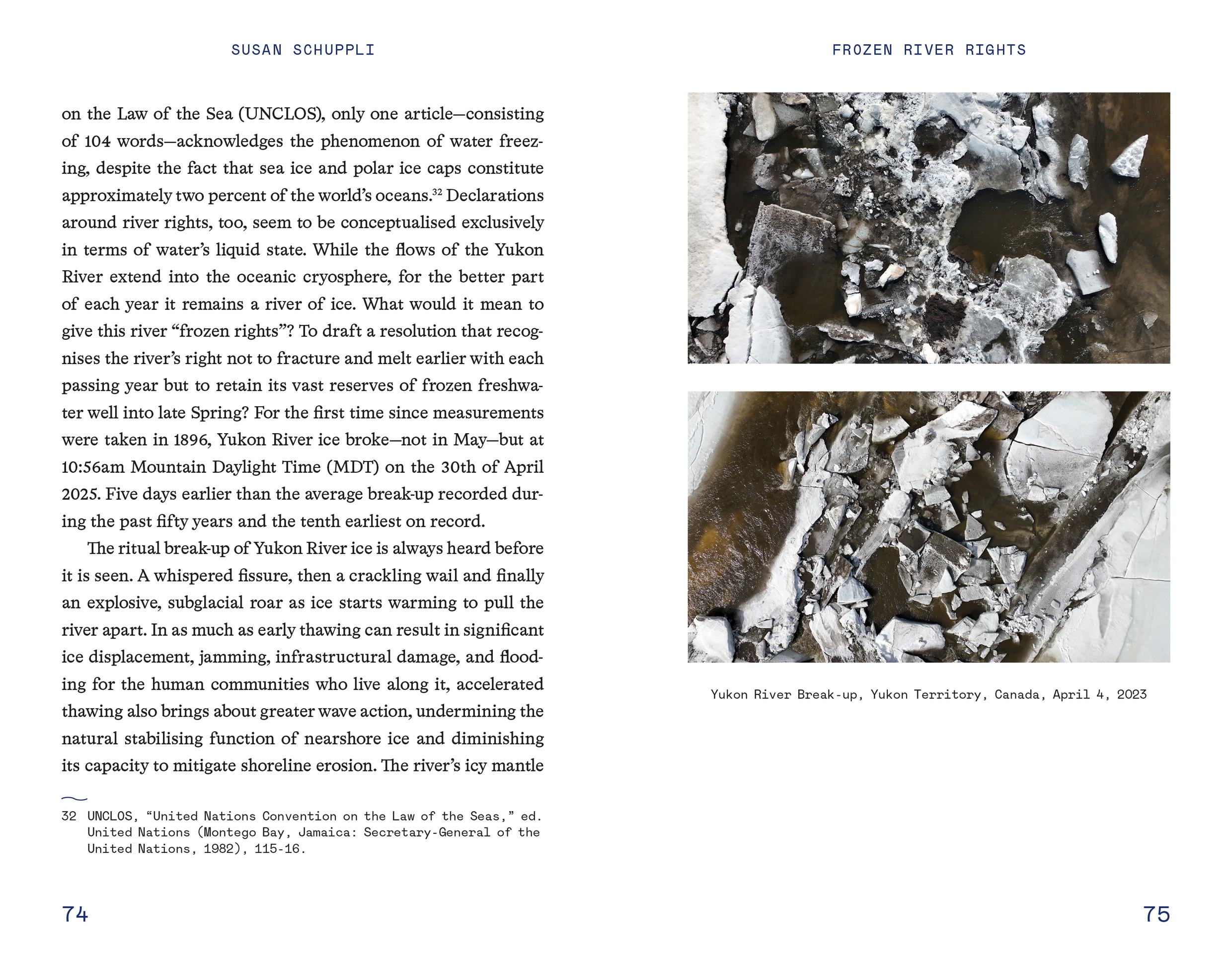
Susan Schuppli proposes reading water and ice as an archive: as a material that holds and transmits memory, including forms of violence that often remain invisible. In dialogue with this, Sara Ahmed suggests that water is not neutral, but reveals structural inequalities and relations of power. What does it mean to think of water as a political, non-neutral archive?
Susan Schuppli and Sara Ahmed show that water is a political archive in the sense that it stands as a material embodiment and record of histories of extraction, violence, and inequality. In Schuppli’s work, rivers, glaciers, and ice formations register the impacts of damming, mining, and climate change, not only as data but as physical inscriptions—traces held in sediment, flow patterns, and frozen strata. Schuppli’s listening practice—learning from ice as it cracks, melts, or remains suspended—suggests that archives are not static repositories but dynamic processes that require ethical forms of attention. Her attention to the rights of rivers to freeze, and to ice as a medium that both stores and withholds information, expands the notion of the archive beyond human systems of documentation. Ice, in particular, becomes a site of latent testimony: it preserves atmospheres, contaminants, and temporalities that can only be accessed through practices of careful listening and attunement, rather than extraction alone.
Ahmed’s intervention complements this by insisting that water is never neutral, but always already shaped by social and political relations—by caste, by gendered divisions of labour, by infrastructures that determine who has access and who does not. Water, in this sense, does not simply record inequality; it actively distributes and materializes it. To think of water as an archive, then, is not only to read what it contains, but to recognize how it organizes experience and exposure in the present.
Bringing these perspectives together, water emerges as a living witness that both holds memory and demands a different mode of engagement. To align with water as an archive and a living witness, is to acknowledge that histories of violence are often slow, diffuse, and embedded in material processes that exceed human perception, yet remain legible if we shift how we listen. It means understanding that the archive is not elsewhere, but already flowing, freezing, and circulating through the environments we inhabit—exposing power not only retrospectively, but as an ongoing condition.
Karoline K. Tampere emphasises a sensory dimension of knowledge—humidity, touch, temperature, rhythm. What role do the body and sensory experience play in these ways of knowing and relating to water?
In Tampere’s text, the body is central to knowing bogs: sensory experiences—humidity on skin, scent in the air, the texture underfoot, subtle temperature shifts, and the rhythm of walking across saturated ground—mediate understanding. Knowledge is not abstracted from the environment but arises through direct, embodied encounter; water and landscape are felt, navigated, and registered through the body as a sensing instrument. This kind of attention foregrounds how perception is already a form of interpretation, where the body translates ecological conditions into lived knowledge—how to move, where to step, when to pause.
This intimate engagement fosters a relational awareness in which the body does not stand apart from the environment but is continuously shaped by it. The porousness of skin, the slowing or quickening of breath, the adjustment of balance on unstable terrain—all become ways of learning from wetlands as dynamic systems. In this sense, knowledge is cumulative and situational, carried in muscle memory and sensory recall as much as in language. It also resonates with shared cultural histories, including Sámi and Estonian practices, where wetlands are not marginal spaces but sites of subsistence, orientation, and meaning.
Within Karolin Tampere’s curatorial practice, this emphasis on the sensory becomes a method for structuring encounters with art and environment. Her exhibitions often invite viewers into conditions where perception is heightened or recalibrated—through atmospheres, materials, and spatial arrangements that foreground touch, sound, and temperature as epistemic tools. Rather than presenting knowledge as something to be read or decoded, her approach encourages a form of attunement, where audiences come to understand through immersion and bodily presence. In this way, curating becomes a practice of staging relations: between bodies, materials, and ecologies, where sensing is not secondary to thinking but constitutive of it.
Sara Ahmed also approaches water as a form of pedagogy, shaped by slow, cyclical, and non-linear processes. In parallel, the contributions of Nat Raha and Himali Singh Soin introduce notions of persistence, return, and temporality. How can we adapt these ideas to the educational programs offered by museums?
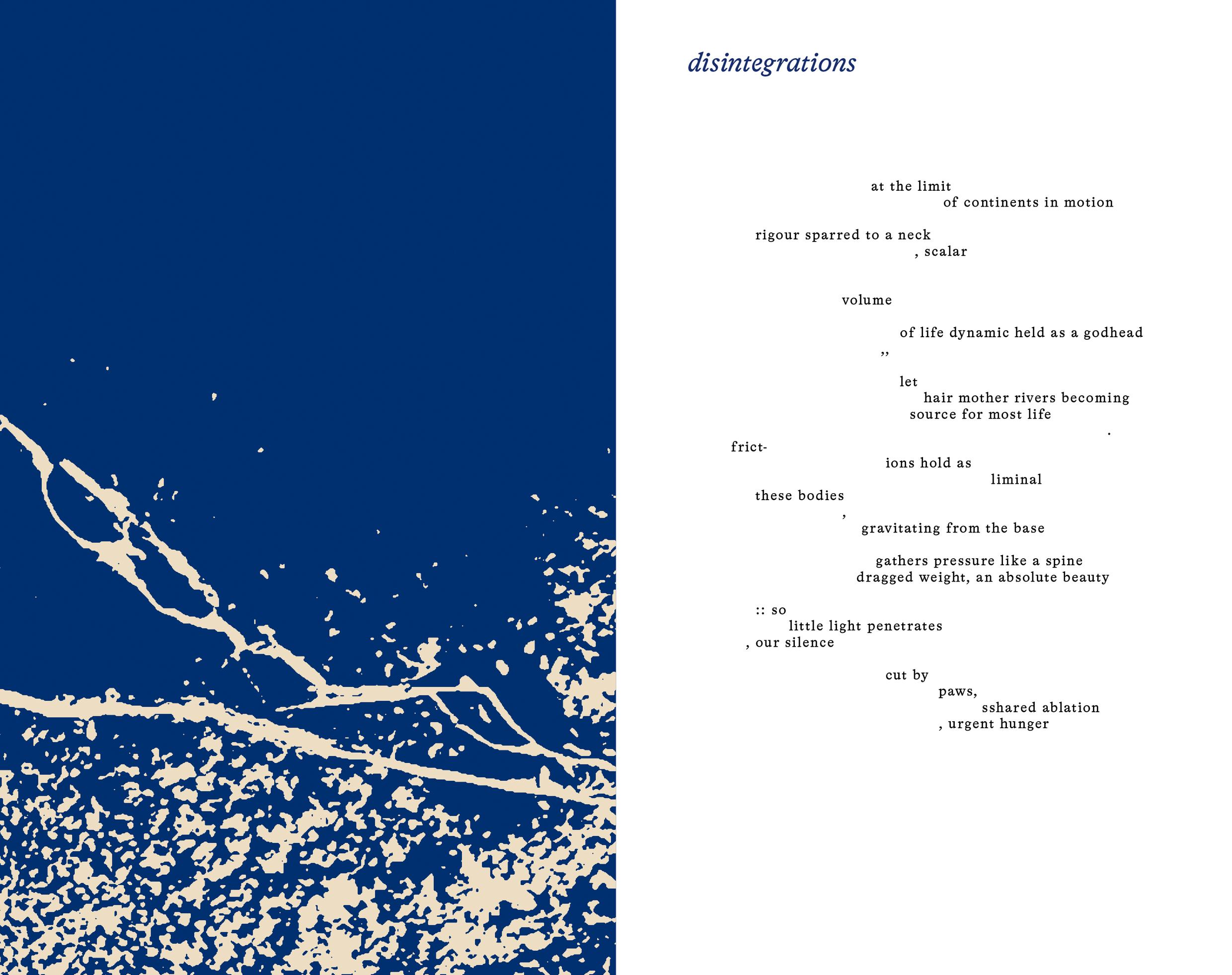
Sara Ahmed, Nat Raha, and Himali Singh Soin invite us to reconsider museum education not as a linear transmission of knowledge, but as a set of cyclical, durational, and embodied practices. Their texts, poems, and visual scores foreground repetition, return, and slow attunement as essential conditions for learning—where understanding does not arrive all at once, but accumulates through revisiting, lingering, and sensing over time. In this sense, pedagogy becomes less about progression and mastery, and more about developing capacities for attention, endurance, and relational awareness.
Museums can adapt these ideas by designing programs that unfold across time rather than within a single visit: iterative workshops, seasonal returns, or guided walks that encourage participants to encounter the same work or environment under changing conditions. Practices of listening—to water within the body and outside it, whether frozen or flowing—can be cultivated through movement, breath, and sensory exercises that shift emphasis away from interpretation toward experience. Learning, here, becomes immersive and processual, where bodies attune to rhythm, memory, and transformation, and where meaning emerges through sustained engagement rather than immediate comprehension.
At the same time, the poetic and visual strategies developed by Raha and Soin expand what counts as knowledge within the museum. Their poetic practice opens up ways of relating and sensing with and beyond the linguistic, expanding the thresholds of understanding and political horizons. Their work operates at the threshold of language, where repetition, fragmentation, and opacity resist easy translation into fixed meanings. Incorporating such approaches into educational programming opens space for forms of knowing that are affective, speculative, and non-linear—allowing participants to dwell in uncertainty and to engage with political questions not only through discourse, but through sensation and imagination. In this way, museum education can become a site for cultivating persistence and return, where learning is understood as an ongoing relation rather than a completed outcome, and where new political and perceptual horizons can gradually take shape.
The book seems to be grounded in a shared conviction: that our future survival depends on transforming our relationship with water. What kind of shared horizon emerges from this choral constellation of voices?
Across their distinct perspectives, the authors mobilize work in relation to different water bodies—rivers, bogs, ice, oceans—developing creative methodologies that function simultaneously as forms of advocacy, attention, and care. What binds these approaches is not a single agenda, but a shared reorientation: away from extractive, human-centered frameworks and toward practices that foreground interdependence, vulnerability, and collective survival. Artistic and poetic strategies become tools for sensing and articulating the entanglements between ecological systems and social life, making visible the ways in which water carries histories, sustains communities, and registers harm. In doing so, they heighten the political solidarity of creative practice, not as representation alone, but as a mode of participation in ongoing struggles over land, resources, and rights that reclaimed grounds for environmental justice and poetic living.
The shared horizon that emerges is therefore not utopian in a conventional sense, but relational and processual: it is built through alliances that cut across geographies, disciplines, and forms of knowledge. These contributions reclaim space for environmental justice while also insisting on the necessity of imagination, proposing ways of living that are attuned to rhythm, reciprocity, and more-than-human coexistence. What comes into view is a choral form of thinking and making, where no single voice dominates, but where meaning arises through resonance, difference, and repetition. In this horizon, survival is inseparable from transformation—of perception, of practice, and of the ethical frameworks through which we understand our place within shared planetary systems.
Finally, how might the relational models and insights advanced in this book be translated into the curatorial and institutional practices of museums of modern and contemporary art?
The essays, poems, and visual contributions in The Word for World is Water emphasize reciprocity and attention towards ecologies and histories that stand in contestation to the colonial, patriarchal and modernist epistemologies that structure our contemporary world. Translating this into museum practice means foregrounding relationality over objecthood. This implies a direct challenge to the directives of gigantism and accumulation, object-centered practices and quantitative reporting, that align with the corporate ideologies of real estate-led urban planning and finance. In the world of fragmentation and uncertainty, that unfolds as a direct result of such ideologies, museums can advocate for practices that provide a counter-current: co-creating with communities, privileging slow-time, acknowledging and dismantling colonial legacies, presenting multisensory and non-anthropocentric narratives, and embracing experimental formats that decenter authority. In short, moving towards institutions as welcoming spaces of dialogue, responsibility, and ecological interconnection.
Authors Ailton Krenak, Susan Schuppli, Sara Ahmed, and Karolin Tampere write from the Amazonian basin, the icy rivers in Canada, the wetlands in Goa, and the Nordic–Baltic peatlands. The book includes artistic interventions by Himali Singh Soin and Karan Shrestha, and a poem by Nat Raha, that extend its inquiry through ritual scores, drawings, and poetry, engaging in glacial journeys, wetlands, and experimentations with language that moves along with tidal force and ecological turbulence.
The book is published by Spector Books and was released in March 2026.