CIMAM Announces the Recipients of the 2026 Outstanding Museum Practice Award (OMPA)
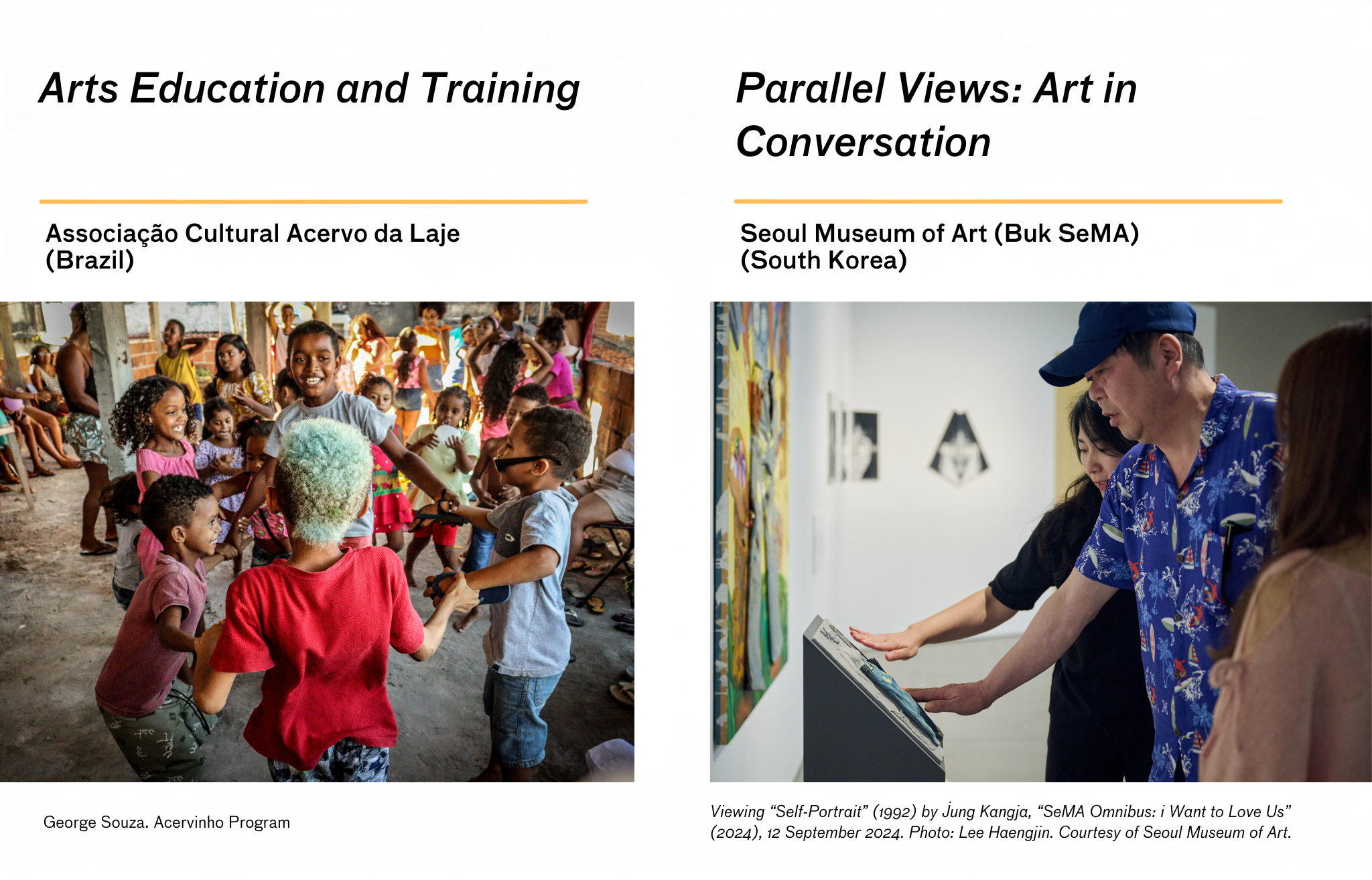
- The 2026 awarded practices are “Arts Education and Training” by Associação Cultural Acervo da Laje (Brazil) and “Parallel Views: Art in Conversation” by Seoul Museum of Art (Buk SeMA) (South Korea).
- The winners were announced today, 17 September 2026, during a CIMAM Board meeting in Barcelona, following an open call that received 33 nominations from 21 countries.
- The award-winning practices will be invited to participate in the CIMAM 2026 Annual Conference, to be held in Harare, Zimbabwe, from 20–22 November.
Barcelona, 17 September 2026 — CIMAM, the International Committee for Museums and Collections of Modern Art, announced today the two museum practices recognized in the sixth edition of the Outstanding Museum Practice Award (OMPA) 2026. The announcement was made during a meeting of the CIMAM Board held today in Barcelona.
The winners of the sixth edition of the Outstanding Museum Practice Award are: “Arts education and training”, by Associação Cultural Acervo da Laje (Brazil) and “Parallel Views: Art in Conversation” by the Seoul Museum of Art (Buk SeMA) (South Korea).
This year’s open call received 33 nominations from 21 different countries, representing institutions of different scales and operational contexts, and foregrounds a plurality of practices rooted in their specific social, cultural, and geopolitical environments. Together, they demonstrate how museums are responding to local realities while contributing to broader, shared questions across the sector.
This year’s edition reveals a strong presence of community-rooted practices, positioning museums as spaces of care, learning, and structural change. Many of the nominations received emerge from education, access, and public engagement areas that are often underrepresented in institutional visibility.
Reflecting on this year’s selection, Kamini Sawhney, Artistic Director, Public Art Projects, BLR Hubba, Bangalore, India and Chair of the OMPA Steering Committee, noted:
The 2026 edition highlights a decisive shift in how we understand museum practice today. The jury was particularly attentive to initiatives that move beyond outreach towards deeply embedded, community-rooted models of engagement. We were interested in practices that demonstrate agency and that are sustained over time.
What unites the selected projects is their ability to propose different ways of being a museum—whether through alternative structures or inclusive frameworks that can be meaningfully adapted elsewhere. These are practices that not only respond to their contexts, but also offer tools for others to rethink their own.
Recognized Practices
Arts education and training
By Associação Cultural Acervo da Laje (Brazil)
Founded on the peripheries of Salvador, the museum operates through local knowledge, relationships, and cultural practices, rejecting external or colonial curatorial frameworks. It positions itself as a space created with, in, and by the community, where affective forms of sharing, listening, and collective authorship shape its structure.
Why was it recognized?
Acervo da Laje has been recognized for its radically transformative approach to museum-making, redefining the institution as a space that is not imposed upon a community, but built from within it.
The jury highlighted Acervo da Laje as a situated, grassroots model, demonstrating how museums can emerge as authentic expressions of their social context. Its strength lies not in outreach, but in origin, offering a compelling example of long-term, community-rooted practice that is both structurally transformative and inspirational for the field.
In the words of Vilma Soares Ferreira Santos and José Eduardo Ferreira Santos, Directors of Associação Cultural Acervo da Laje:
We at Acervo da Laje are very happy and grateful to receive this recognition from CIMAM, particularly for its careful attention to our practices and our work with Black, women’s, peripheral, and Brazilian aesthetic memories, rooted in Salvador’s Subúrbio Ferroviário.
As a House-Museum-School, over the past sixteen years Acervo da Laje has worked to democratize access to art and the memories of peripheral communities through curatorial and educational practices. Our work includes an ongoing program of workshops, cataloguing, exhibitions, and dialogue with a wide range of audiences, particularly children, young people, and women from peripheral communities and beyond.
Receiving this recognition from CIMAM is of great importance to us, as it strengthens and encourages the pioneering work we have been carrying out in Brazil from the periphery. We hope that this recognition will also help encourage and inspire many other initiatives dedicated to Black, peripheral, and women’s memories in Brazil to be recognized and supported by local and national public authorities.
As our history continues to be built collectively, we would like to thank everyone who has been and continues to be part of it, especially our families, our territory, and the suburban community to which we belong.
Learn more about Arts education and training
Parallel Views: Art in Conversation
By Seoul Museum of Art (Buk SeMA) (South Korea)
Buk SeMA—"buk" means "northern"—is SeMA's largest branch. Rather than creating separate programs for people with disabilities, Parallel Views fosters shared experiences between people with and without disabilities, challenging conventional approaches to accessibility and moving beyond tokenistic inclusion.
Why was it recognized?
Buk SeMA’s practice has been recognized for advancing a thoughtful and replicable framework for accessibility and inclusion, centered on the integration of diverse audiences.
The jury highlighted the project’s emphasis on co-presence, dialogue, and mutual learning, positioning accessibility as a core museological methodology rather than an add-on. Its clarity, consistency, and replicability make it a valuable model for institutions seeking to develop more inclusive practices.
As Choi Eunju, Director of the Seoul Museum of Art, explains:
Receiving the Outstanding Museum Practice Award is very significant in that it recognizes the way Parallel Views: Art in Conversation has approached accessibility. Rather than understanding accessibility only as the removal of physical and informational barriers, this program has explored it as a way of building relationships—bringing people with and without disabilities together to experience art through dialogue and to share each other’s perspectives in the museum. What began as an educational initiative has gradually grown into collaborations with a foundation for the disabled, corporate partners, and civic organizations, extending these relationships beyond the museum itself. We see this award as an encouragement for the Seoul Museum of Art to continue exploring how museums can build meaningful connections with society.
Learn more about Parallel Views: Art in Conversation
The 2026 OMPA recipients will be at CIMAM Annual Conference in Harare:
The award-winning practices of the 2026 edition of the CIMAM Outstanding Museum Practice Award will be invited to participate in the CIMAM 2026 Annual Conference, to be held in Harare, Zimbabwe, from 20–22 November, where they will have a dedicated presentation within the conference program to share with an international audience of modern and contemporary art museum directors and curators the context in which the practices emerged, how they have evolved over time, and the impact they have had on their communities.
Notes for Editors:
About the Outstanding Museum Practice Award:
Established in 2021, OMPA encourages museum professionals to share exemplary practices that can inspire the international museum community. It promotes shared learning, collaboration, and resilience by highlighting models that respond to local contexts while addressing broader challenges in modern and contemporary art institutions, and whose approaches may be adapted or replicated across different contexts.
In a context of increasing social, political, and environmental complexity, OMPA recognizes practices that contribute to redefining the role of museums in society. Recognition highlights initiatives that go beyond scale and resources to generate meaningful, long-term impact on communities and institutional structures.
OMPA 2026 Steering Committee:
- Kamini Sawhney (Chair), Artistic Director, Public Art Projects, BLR Hubba, Bangalore, India.
- Joselina Cruz, Director and Curator, Museum of Contemporary Art and Design (MCAD), Manila, Philippines.
- Shabbir Hussain Mustafa, Chief Curator, Singapore Art Museum, Singapore.
- Amanda de la Garza, Deputy Artistic Director, Museo Nacional Centro de Arte Reina Sofía (MNCARS), Madrid, Spain.
- Pablo Lafuente, Artistic Director, Museu de Arte Moderna do Rio de Janeiro (MAM Rio), Rio de Janeiro, Brazil.
- Stephanie Rosenthal, Director, Guggenheim Abu Dhabi Project, Abu Dhabi, United Arab Emirates.
About CIMAM
CIMAM – International Committee for Museums and Collections of Modern Art – is an Affiliated Organization of ICOM (the International Council of Museums), and the only global network of modern and contemporary art museum experts in the field. CIMAM members are directors and curators working in modern and contemporary art museums, collections, and archives.
Founded in 1962, CIMAM’s vision is a world where the contribution of museums, collections, and archives of modern and contemporary art to the cultural, social, and economic well-being of society is recognized and respected.
CIMAM's mission is to foster a global network of museums and museum professionals in the field of modern and contemporary art and provide a forum for communication, cooperation, information exchange, and debate on issues of common interest among museums, non-profit collections, and artists, and museum professionals interested in modern and contemporary art to represent their interests in accordance with the ethical principles and values of the ICOM Code of Ethics and CIMAM's Code of Ethics