Vaishnavi Kambadur
Conference Report. December 2025
In my travel grant application, I wrote that I wanted to attend Françoise Vergès’s keynote. When the moment came, I found myself absorbing everything she said, ready to carry it back with me to India. She spoke about decolonizing, anti-racism, feminism, and resistance not as abstract concepts, but as real, lived experiences. This was my first time at the CIMAM conference, of such scale and intensity, surrounded by people from such diverse experiences. Her keynote felt like it was speaking directly to me in the room. It set the tone for the breakout groups with the question – how do museums stand in solidarity with the people of the world?
Break-out groups
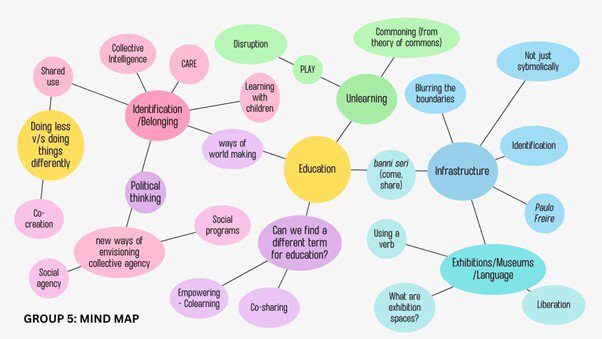
The breakout group was one of the key highlights of the conference for me. It was brilliantly moderated by Charlotte Day and included Julia Bjornberg, Ana Paula Cohen, Mercedes V, Zoran Eric, Yilmaz Dziewior and Marko Daniel. The breakout group summed up Chus Martínez’s narrative of the day where we used our “collective intelligence” to brainstorm alternative ways of addressing the term(s) – educational infrastructure. While I had volunteered to take notes, for me the process was more than taking down points, I wanted to present something tangible and used my design knowledge to create a mind map using shared words such as unlearning, commoning and empowering.
Museum visits
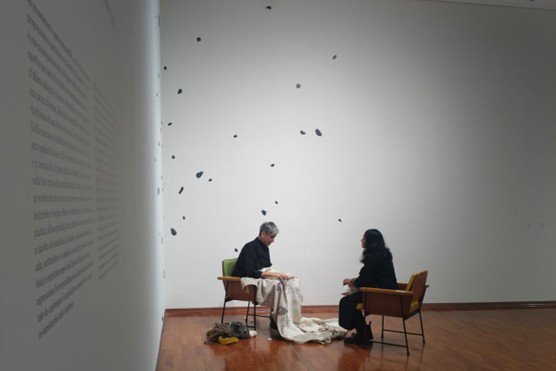
We visited GAM – Italy’s first public art museum - which was exhibiting Linda Fregni Nagler. Anger Pleasure Fear, curated by Cecilia Canziani, it had some magical photographs drawing from both memory and material culture, and a large-scale installation, The Hidden Mother (2013). I was delighted to discover Claudia Losi’s performance, Tapestry / Fulfilling life that lives which began in 1995. Since I also specialize in textile history, I spent much of this visit sitting with the artist as she embroidered woollen flowers onto the work. We discussed questions like whether she was creating a time capsule. I also noticed similarities between her practice and the intergenerational embroidery work that happened in India before independence—when no one knew how long a piece would take or how many hands would contribute to it over time.
The museum visits on the first day ended with Fondazione Sandretto Re Rebaudengo where woven, knitted and digitally manipulated works by Rosemarie Trockel (1986), Pae White (2010) and Sarah Lucas (2011) succeeded in their technique and tactility. Textile making and knitwear technology employed by artists has also drastically shifted in the last 15 years, this shift was apparent through the curatorial placements of the works. I was interested in label writing, especially the translation from Italian to English. Where I come from, colonial influence means we typically write in English first and then translate into local languages. Seeing the reverse, Italian as the original language, was surprising. I think we could have had choices between museums or longer visits at some museums over the others, to be able to analyse them further.
Historic v/s Contemporary
I always find it interesting when the city’s history merges with modern and contemporary art. I visited the Egyptian Museum where I spotted bales of cotton and linen cloth, as well as colour mixing and dye techniques, the scale of which fascinated me. They displayed everyday objects, a thread that followed mw throughout the day. The interpretation of “mapping desires” using new methods of museum making was interesting, especially with the project presentation by Azu Nwagbogu who continues with his research journey, despite facing resistance. I also wish that one of the panel discussions had interactions between artists and curators who had closely worked with each other. Speakers such as Rustom Bharucha, Onome Ekeh and Karen Archey showed me it's possible to curate projects on my own terms, to explore topics beyond industry expectations and follow my research wherever it leads, even in unexpected or contradictory directions. On the third day, Bart De Baere presented a pie chart illustrating the positions such as curators, directors, educators, that form the CIMAM community. At the next conference, I'd like to hear curators answer practical questions like: how did you approach curating this project with economic, social and political obstacles (partly addressed by awardees on day 1)? What was your methodology? What challenges did you face early in your career?
Gratitude
I am grateful to Chitra Talwar for this opportunity. This conference empowered me to speak my own truth and gave me access to a diverse network of art professionals. I thank Inés Jover and Isabel Sozzi for visa support; Alessia Palermo from Fondazione Sandretto Re Rebaudengo, for a meaningful conversation about culture during our bus journey between museum visits and my fellow travel grantees, with whom I had the most profound interactions at every step of the way.
Biography
Vaishnavi Kambadur gained early career experience at knitting mills, export houses, and independent design studios in India. At every stage, she sought inspiration and engaged with art and museum spaces, which shaped her perspective on the intersection of creativity and cultural institutions such as the Crafts Museum in Delhi. This foundation led her to pursue an MA in Fashion Studies at The New School for Social Research, where she was awarded the Geraldine Stutz Award as a young professional. Museums became integral to her education through electives at the Cooper Hewitt Museum.
Under Professor Hazel Clark’s supervision, her MA thesis introduced her to fashion curation, which became evident throughout her subsequent work. Using ethnographic methodology, she interned at the Textile Arts Centre in Brooklyn, where she engaged with diasporic artists working with fiber as their medium. As a graduate teaching assistant for courses including Fashioning Micro-utopias and Fashion History, she brought curators like Harold Koda into the classroom. Simultaneously, she worked at Christie’s in their Indian and Southeast Asian art department, exploring South Asian modern and contemporary art, particularly from Baroda and Bengal. Her fascination deepened when she understood how a Ranjani Shettar artwork from Bangalore related to craft traditions from North Karnataka.
After three years in New York, she returned to India in 2019 to join the Museum of Art Photography (MAP) in various capacities. As part of the founding exhibitions team at MAP, she contributed to more than seven physical exhibitions and eight online experiences. Working at a new museum in India allowed her to explore inclusion methods, such as developing detailed audio guides. Currently, she balances her curatorial career with a teaching role at Pearl Academy, Bengaluru. She is committed to evolving as a curator by responding to the needs of a new generation.
Vaishnavi Kambadur, Independent Curator and Assistant Professor, Pearl Academy, Kala Hubba, Bengaluru, India, has been awarded by Chitra Talwar.