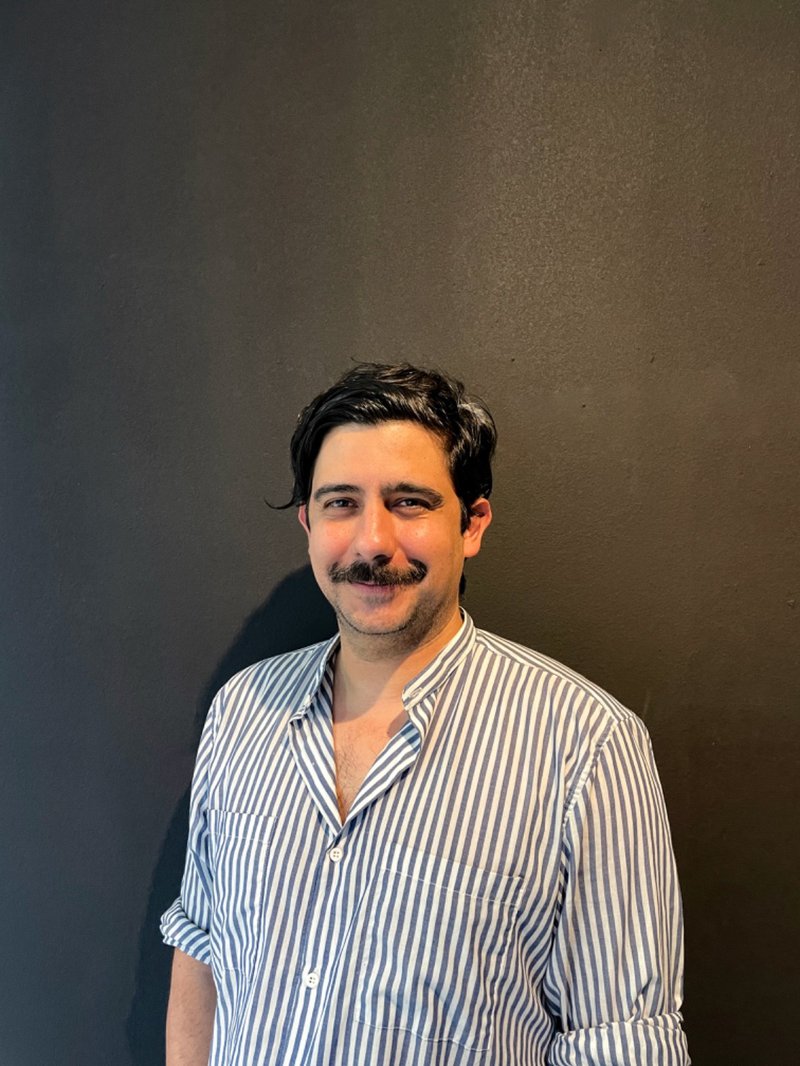
Patricio Orellana
Conference Report. December 2025
During the introductory moments of her keynote on Day 2 of CIMAM’s Conference, Elizabeth Povinelli offered something like a disclaimer. She noted that her presentation had been scheduled, by the careful and attentive conference organization, on the so-called “positive day”—the “negative,” presumably, having been Day 1, when Françoise Vergès addressed the profound crises currently facing museums. With the dry, sustained wit she would effectively deploy throughout the talk, Povinelli confessed her perplexity at this framing and cautioned the audience against expecting an overtly optimistic presentation. The moment left me wondering about the terms of such positive/negative divide. After all, on her “positive” speech, Povinelli would go on to propose “depressive realism” as the most adequate affective stance for cultural practices nowadays. Conversely, can one not hear an affirmative, forward-looking register in Vergès program of “absolute disorder”? Were not her reflections on the tactical balance between slowness and rapid response ultimately propositional? In this sense, the conference itself became an opportunity to reconsider the opposition between critique and proposal, between what was described as the “paranoid” and the “redemptive” dimensions of curatorial and cultural practice. Rather than having to choose between them, the overall effect of CIMAM’s conference was to foreground their necessary co-presence, and to prompt a rethink of how their dynamics might be articulated differently. In what follows, I would like to reminisce on the conference as a field of tensions—a cluster of conversations that did not rush to resolve contradictions—and to point to some of the questions that I brought home.
(If I devote more space to the performances that opened each day, it is because this curatorial decision struck me as particularly consequential. Rather than functioning as cultural supplements, these performances operated as dense thinking devices. By activating the senses at the very beginning of each day, they shaped the affective and intellectual register through which subsequent discussions were received. Long after specific arguments faded, the performances continued to resonate in my memory, condensing many of the conference’s most enduring insights and serving as mnemonic anchors, as sensitive metaphors, for the experience as a whole.)
A sense of contradiction and ambivalence was already inscribed in the conference’s title. Enduring Game suggests a coexistence of joy and toil, of the playful and the painful, of the relief we may find in games and the alarming vigilance required to endure. To emphasize endurance is to shift attention away from apocalyptic rhetorics and toward a temporality of long duration—a reminder that this condition —whatever we want to call it— is likely to last. The notion of an enduring game also calls for strategic thinking, for carefully anticipating the next move, a game that is not meant simply to be won, but to be kept in play. This ambivalent dynamic between pleasure and strain was further expanded by the Day 1 performance, Alessandro Sciarroni’s Don’t Be Frightened of Turning the Page, interpreted by Marco Bertani, with music by Paolo Persia. The piece consisted of a single, deceptively simple action: a dancer spinning in circles within a squared surface for nearly half an hour. What unfolded was a sustained meditation on endurance understood not as passive resistance but as an active, embodied decision—one that demands continuous movement. The gesture fused play and effort: it echoed the children’s game of spinning oneself dizzy before play can begin, while simultaneously foregrounding the intense labor, control, and physical skill required to maintain the action over time. Through repetition, the performance opened a mode of thinking that refuses the familiar opposition between stasis and progress, proposing instead a temporality grounded in persistence. Each rotation was nearly identical yet never the same, allowing repetition—with its minute variations—to acquire a poetic charge, as difference quietly emerged from within sameness. The temporal complexity unfolded by the performance was further developed in Françoise Vergès’s keynote, Being Slow/Being Fast, where she proposed a necessary—if seemingly contradictory—articulation between slowness and speed as strategies for political and cultural practice. What emerged across both registers was not only a theory of time, but a tactical political problem: how to act when change might unfold not through rupture, but through duration.
One theme that recurred throughout both the lectures and the small-group discussions concerned the relevance of museum and curatorial practices. During the breakout sessions following the main lecture on Day 1, we discussed how far-right movements that have come to power in several countries have effectively mobilized an anti-intellectual stance, calling into question the public value of art and culture. This growing demand to justify the very existence of museums and cultural institutions calls for a recalibration of how we understand the political positioning of art and culture—a recalibration echoed in the “Slow/Fast” tactics proposed by Vergès. These conversations opened a broader set of questions about relevance, particularly the tension between defensive postures and more inventive, transformative gestures. Art and cultural practice have long defined themselves through rupture—through critique, audacity, and the desire to break with what exists in the name of what has yet to come. Yet the present moment calls not only for strategies of invention and negation, but also for those of protection and maintenance—positions that risk being read as conservative or reactionary. What political risks arise when traditions grounded in rupture turn toward defensive modes? How might negativity be rethought so that it does not merely echo the dismantling forces already threatening cultural life? And how can institutions sustain a critical edge without yielding either to paralysis or to fantasies of total collapse, particularly when survival itself has become a political task?
In reflecting on how best to assess the political valence of artistic practice, Povinelli prescribed a position of “depressive realism,” which she posited against both the paranoid outlook associated with the most acute forms of negative criticism, and a potentially excessive faith in the reparative powers of art and culture. The term stayed with me, though I found myself drawn to a different inflection of it. Both “depression” and “realism” inevitably reminded me of the work of the late Mark Fisher. Does not depression signal something else than resignation or acceptance, perhaps even a refusal to reconcile oneself with the reality of what exists? Doesn’t it sound a quiet insistence that this cannot be all?
Another concept that repeatedly resurfaced for me throughout the conference was that of translation. Being abroad, surrounded by peers working in markedly different institutional, cultural, and political contexts, I became aware of the constant work of translation involved in simply being present. How to describe the conditions in which one works, how to make oneself readable; which experiences travel easily across contexts, and which resist easy transposition; what gets lost, what becomes opaque, and what unexpectedly resonates. Translation appeared less as a technical operation than as a form of labor inherent to encounter—one that demands listening, interpretation, and a willingness to remain with partial understanding. Rather than producing equivalence, it exposes difference, asking not to resolve it too quickly. This became especially palpable during the breakout sessions held on Days 1 and 3. Working in smaller groups, the discussions took on a more horizontal and tentative quality, shaped as much by what could not be easily shared as by what could. The desire to “learn from” one another—to extract applicable models or strategies—was also accompanied by the necessary realization that what seemed transferable at first glance frequently broke down under closer scrutiny. Common ground, when it emerged, did so less through consensus than through fissures: through moments of misalignment and hesitation. (These dynamics echoed Françoise Vergès’s critique of the museum’s claim to universality, which she described not as a neutral horizon but as a mechanism that smooths over historical and political asymmetries.) Against such universalizing impulses, translation appeared instead as a situated practice, one that insists on context, acknowledges opacity, and resists the fantasy of seamless circulation. The performances that opened Days 2 and 3 gave particularly forceful form to these questions. Abdullah Miniawy’s Peacock Dreams, performed alongside trombonist Jules Boittin, unfolded as a layered act of translation across multiple registers —an exploration of the resonances across languages, between musical and poetic traditions, but also between the music and the word, between the animal realm referred in the lyrics and human utterance. Diana Anselmo’s Pas Moi foregrounded translation as an unavoidable and asymmetrical condition of artistic practice. Structured as a silent lecture-performance conducted in sign language, the work drew on cultural and historical archives and embodied forms of knowledge to expose the audist and phonocentric assumptions embedded in the technologies that shaped the histories of cinema and popular music. In Pas Moi, translation was not a matter of accommodation but of epistemology—an insight I intend to continue to reflect on as potential key for approaching artistic practices in the contemporary landscape more broadly.
Taken together, the performances, lectures, and discussions at CIMAM did not offer solutions so much as orientations. Endurance emerged not as passive persistence, but as a strategic commitment to staying in play; translation, not as the smoothing of difference, but as the labor of listening across asymmetries that cannot—and should not—be resolved. If the conference resisted the comfort of optimism as much as the paralysis of critique, it did so by insisting on duration: on the slow, “enduring game” of sustaining institutions, practices, and solidarities under pressure. What I carried home was less a set of answers than a recalibration of attention.
Biography
Patricio Orellana (Buenos Aires, 1982) received a Licenciatura from the Universidad de Buenos Aires and a PhD from New York University, with a dissertation focused on Argentine art and literature of the 1960s. He completed Critical and Curatorial Studies at the Independent Study Program at the Whitney Museum of American Art in New York. As a Curatorial Fellow, he co-curated After La vida nueva, an exhibition that brought together artists exploring language, land, and territory through the lens of what was termed “Third World New York.” He then served as Exhibition Coordinator.
In 2022, he returned to Argentina and joined the Museo de Arte Moderno de Buenos Aires, where he curated Mad Toys. Destruction and Avant-Garde in 1960s Argentina, reflecting on the destructive gestures of neo-avant-garde artists through works from the museum’s permanent collection; and most recently Self Portrait, a retrospective of great Argentine artist Dalila Puzzovio, positioning her artistic and fashion practices as precursors to contemporary concerns around identity performance and media representation.
His writings have been featured in book form, exhibition catalogues, academic journals and other media outlets, such as e-flux.
In parallel with his curatorial work, Patricio has been part of the publishing house Caja Negra Editora’s team, and teaches courses on literature and philosophy at New York University in Buenos Aires.
Patricio Orellana, Curator at Museo de Arte Moderno de Buenos Aires in Buenos Aires, Argentina, has been awarded by the Getty Foundation.