Portia Placino
Conference Report. December 2025
I was excited to receive the CIMAM travel grant and attend the annual conference in Turin. Yet as the weeks unfolded, excitement slowly gave way to anxiety, as the visa process revealed itself to be far more tedious and uncertain than anticipated. One of the travel grantees from the Philippines was ultimately denied a visa, despite the support and documentation extended by CIMAM. This became a wake-up call for me. Having received Schengen visas in the past, I did not expect significant obstacles, particularly given the prestige of the program. Instead, the process foregrounded the limits of what globality in the arts actually allows. It revealed how access to global discourse remains conditional, filtered through state power, nationality, and deeply uneven access to mobility. For Filipinos—and for many curators from the Global South—movement is never assumed; it must be justified and proven, again and again. Enduring Games, the theme of the conference, began well before I ever set foot in Turin. This experience is shared by many grantees, and by practitioners from the Global South more broadly: global power relations become most visible not in theory, but in the simple question of who is able to move freely, and who is asked to wait, explain, or be denied the possibility to participate.
Arriving in Turin, the conference unfolded as an intense convergence of ideas, institutions, and contexts. CIMAM opened up valuable opportunities to listen closely to how colleagues across regions grapple with questions of funding, relevance, care, sustainability, and responsibility. These moments of learning are vital. And yet, they also sharpened an awareness that global dialogue often rests on uneven ground. While we may share a language of contemporary art theory, institutional critique, and shifting power dynamics, the conditions under which this language is produced and circulated are not equal. Funding and labor precarity may be global conditions, but in places like the Philippines, they are intensified by fragile infrastructures, limited state support, and the constant negotiation of survival beyond the cultural field. Here, globality is not an abstract horizon but a pressure—one that intersects with urgent and overlapping crises. One of the most pressing has been the recent, unmitigated flooding across the archipelago. While flooding during the rainy season is not new, the scale and lack of control surrounding recent events have been deeply disruptive to everyday life, producing anxiety and precarity for many Filipinos. Reports point to unchecked greed and systemic corruption in funds meant to mitigate the effects of harsh rain and changing climate—conditions that shape society as a whole, extending even to the vulnerability of museums, artworks, and artistic spaces.
It was against this backdrop that the keynote by Françoise Vergès resonated most deeply with me. Her reflections on uneven contexts and enduring struggles foregrounded the fragility of the sociopolitical dynamics within which we operate. Decolonization, though now a familiar and necessary discourse in the arts, can at times become abstract. Decolonization as an ongoing struggle—one that cannot be reduced to representation, inclusion, or institutional branding. For contexts such as the Philippines, this framing is especially charged. Environmental devastation, extractive economies, and the persistence of systemic corruption can all be traced back to centuries of colonial rule that embedded inequality into governance, culture, and everyday life. These histories cannot simply be disavowed, nor can they be neatly resolved. Decolonization, in this sense, is also a confrontation—with complicity, and with the discomfort of recognizing how deeply these histories continue to shape the present.
The conference also foregrounded the role of CIMAM itself—as a platform that brings critical narratives into visibility while inevitably operating within existing hierarchies of power and privilege. CIMAM is important precisely because it creates space for difficult conversations, for voices that articulate struggle rather than consensus. At the same time, participation exposes the asymmetries that structure global professional networks. For many travel grantees, myself included, there is a shared experience of translation—not only of language, but of lived realities. We arrive grateful for the opportunity to learn and exchange, yet often confronted with the need to explain, contextualize, and render visible experiences shaped by scarcity, struggle, and historical violence. These contexts are not always immediately felt within more privileged contexts, and the labor of making them visible becomes inseparable from our participation.
This labor of translation is not incidental; it is structural. It raises questions about whose knowledge travels effortlessly, whose experiences circulate as theory, and whose realities require constant clarification. The discussions in Turin made clear that global gatherings are not neutral spaces of exchange, but carefully managed sites where access, authority, and legitimacy are continuously negotiated. If the ideas generated are to extend beyond the conference and resonate more broadly, we must contend with these asymmetries—not as abstract critiques of inclusion, but as material conditions that shape who is heard, who is invited, and who remains at the margins. In this regard, the upcoming annual conference in Zimbabwe marks a step in the right direction—foregrounding narratives and urgencies articulated on their own terms, and deliberately privileging contexts that have too often been spoken for rather than listened to.
Ultimately, the experience of Turin was shaped as much by the difficulty of arrival as by the layered encounters that followed. It offered no easy resolutions, but it sharpened questions that continue to matter: who is able to move freely, who is required to justify their presence, and how histories of inequality persist even within spaces committed to critical reflection. In this sense, the conference reaffirmed that globality in the arts is not simply about visibility, exchange, or networking. It is about power—about the structures that govern mobility, define legitimacy, and determine whose participation is assumed and whose remains contingent. To engage globality responsibly is to remain attentive to these conditions, and to the uneven contexts from which we come, and to which we must inevitably return.
Biography
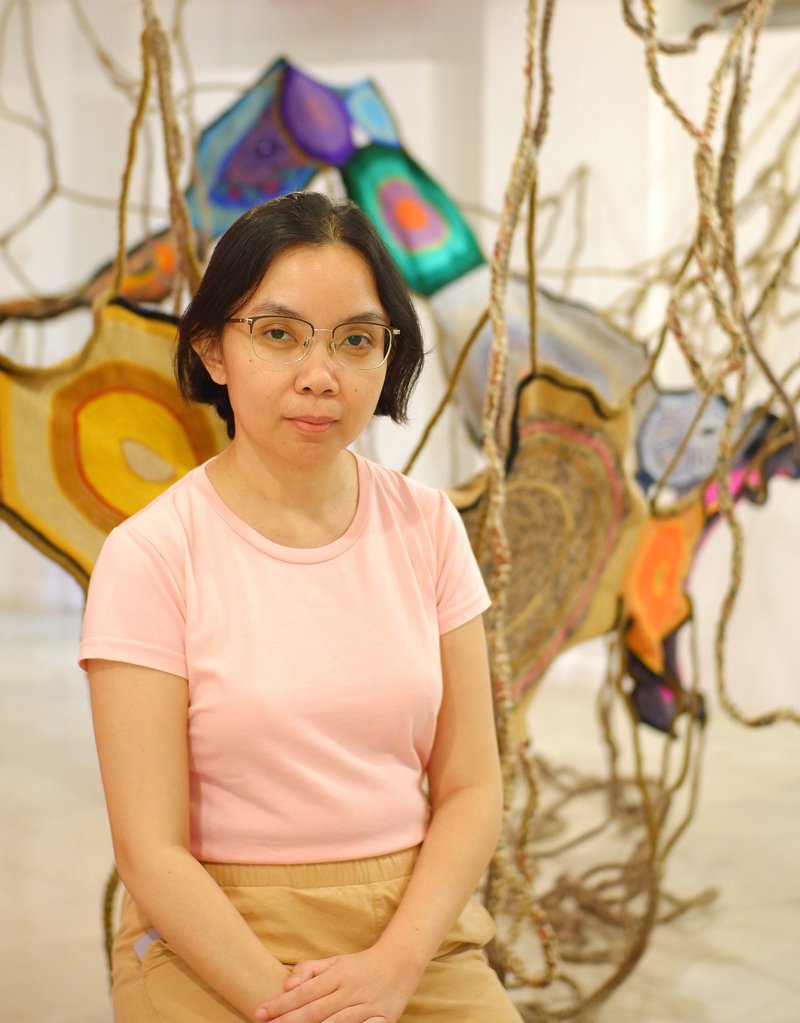
Portia Placino is a curator and independent arts writer based in Manila, Philippines. She currently runs the JCB Gallery at the Philippine Women’s University. Her writing has appeared in ArtAsiaPacific, ArtReview, ArtSG, Art+ Magazine, Spot.ph, Esquire Philippines, and various local and international academic publications. She received the Ateneo Art Awards–Purita Kalaw Ledesma Prize for Art Criticism in 2021 and has been awarded writing and research residencies and grants in the Philippines, Germany, Korea, Belgium, and Singapore. Her work focuses on marginal and off-center art practices, including regional contemporary art, feminist perspectives, and sociopolitical critique. She examines the place of contemporary art in a society marked by precarity and struggle.
As curator of the JCB Gallery, Portia led its transition from student- and alumni-based shows to critically engaged and socially responsive programming. She presented Jomar Galutera’s politically charged White Elephant Project, addressing remnants of the dictatorship, and curated a posthumous exhibition of Brenda Fajardo’s prints and archives, exploring the contributions and challenges of women artists in a still male-dominated art world. For 2025, she initiated projects featuring Aze Ong’s experimental fiber installations and Veejay Villafranca’s documentary photography, among others. She believes institutional spaces—especially those free from market pressures—are crucial for fostering experimentation, discourse, and critical engagement. Continuing critical perspectives and practices expressed in her curatorial vision and projects remain key to growing both her practice and the space she runs.
Portia earned her BA in Art Studies from the University of the Philippines and completed her academic requirements for an MA in Art Studies (Art Theory and Criticism) at the same institution. She currently lectures at the Center for International Studies at UP Diliman and the School of Culture, Arts, and Performance at De La Salle–College of Saint Benilde.
Portia Placino, Gallery Administrator and Curator at JCB Gallery, Philippine Women's University in Quezon City, Philippines, has been awarded by Fernando Zobel de Ayala.