Jimena Galán
Conference Report. December 2025
I attended the CIMAM 2025 Conference as part of the travel grants program. For me, and for the collective I am part of, La Revuelta, it is not possible to cover the costs of a trip like this. The program represents an opportunity to be present in spaces where decisions are often made from geographies very different from our own.
The conference served as a platform to observe how museums are being conceived at different scales. Topics such as curatorial practices, institutional change, cultural policies, and sustainability were discussed. The activities were well organized, allowing time for exchange, exhibition visits, and walks through the city. I value the fact that art was an integral part of the gathering, rather than a parallel or closing activity, as often happens in other forums. However, I found it difficult to see myself reflected in many of the conversations.
Central America was not represented in the program. This does not only mean that there were no presentations from the region, but that the questions being asked did not stem from our conditions. Important issues were discussed—such as the role of the museum in the face of current crises, the urgency of transforming it, and the need to connect it to territories—without acknowledging that in places like ours, public institutions that sustain cultural life often do not exist. In Guatemala, most artistic work takes place independently, without state support, without cultural policies, and within contexts marked by violence, exclusion, and dispossession.
During the feedback session, curator Patricio Orellana mentioned that often it is not enough to translate the language; it is also necessary to translate context, time, and opportunity. That phrase summarizes what I felt at several moments. Most of the frameworks for discussion did not consider the structural asymmetries that determine where we are able to speak from. This is not a matter of symbolic representation; it is a matter of place, of possibility, of real access.
I was also left with questions that were not voiced aloud: What happens when we speak of countries where basic needs are not met, which is a fundamental condition for being able to talk about the role of culture? We spoke of the body as territory and as agents, yet our bodies are constantly threatened by structural violence. There was talk of limited resources and barriers to access—but what happens when those limitations are not temporary but permanent? What happens when inequality is not a circumstance, but a structural condition?
I found especially relevant a question that emerged in one of the discussions: who gets to sit at the table, and why are they allowed to sit there? In our case, participation does not imply having been part of a system, but rather working outside of it, often with minimal resources and without guarantees. I identified strongly with the mention that some people have been forced into exile or criminalized for their cultural practice. These realities are not abstract to me.
In another intervention, it was suggested that instead of looking for formulas to “teach” other geographies, we should learn from the processes that are already taking place. In this sense, I recognize the value of being in a space where these tensions can be expressed. Having the opportunity to share—and also to leave with unanswered questions—was part of the learning experience.
At the same time, the conference did offer moments of listening and possibility. In the case studies, it was easier for me to situate myself, to recognize points of connection, and to identify tools that could be adapted to our projects. I was particularly interested in Portia Placino’s intervention at the end of the conference, at which she proposed inviting more speakers from decentralized contexts. It would also be meaningful to include one or two participants from the travel grants program to share their projects. This would help acknowledge that what is often proposed as a future from certain centers is already a daily practice in other regions.
Françoise Vergès spoke about the difference between thinking from a collective perspective versus an individualist one. She named the difficulties of building from contexts where the past has not been processed, and therefore where it is also impossible to project a future. This resonated deeply with our reality in Guatemala, where armed conflict, impunity, and inequality continue to shape every social and cultural process. Rustom Bharucha proposed thinking of the museum not only as a visible structure, but as something sustained by the land on which it is built. He asked whether making also implies unmaking. Both interventions pointed to the need to name limits and to think of strategies that do not idealize institutions but rather question them.
Another conversation that resonated with me concerned the supposed need to simplify language to open the museum. In my context, this is not a debate. We do not expect people to have a prior theoretical framework to participate. At La Revuelta, we seek different forms of relationship: visitor notes, non-mediated activities, projects with children, collaborations with people outside the cultural field. We work with what is available—not to illustrate a deficit, but because we understand that if we want different publics, we need different processes.
There was also discussion about the position from which we respond to the tensions between what we are asked to do and what we actually do. Elizabeth Povinelli spoke about this gap, illustrating it through exercises in fiction. I then wondered how this type of reflection is received in a context like Guatemala’s, where artists are criminalized, curators live in exile, and many cultural practices lack basic rights. It is not only about imagining futures, but about naming the violences that prevents them from being built.
I found it important that, at the end of the conference, the voices heard during the feedback session were primarily those of participants from the travel grants program. It was a clear gesture of openness, although I continue to believe that listening is not always enough if structures are not adjusted. Those of us in the program did not attend only to listen; we also came up with something to say.
I close this report with a statement: being present was important, but being present does not mean being included. And yet, it is necessary to continue insisting.
This year, the number of people who accessed the travel grants program was notable. The diversity of experiences, languages, and geographies was palpable. I hope that in future editions, more people will be able to approach this space not only as guests, but as active interlocutors. The opportunity to provide feedback on the conference, to share our questions and experiences, was a gesture I truly value.
I am grateful for the time and effort the CIMAM team dedicated to making our participation possible, for accompanying us through every logistical detail, and for giving us the space to share from our own realities.
During one of the sessions, Povinelli spoke about the risk of asking others for a magical solution. That idea helped me recognize that, from our own position, we might also fall into the mistake of expecting these spaces to transform us completely. I felt reflected in that warning: I do not return with definitive answers, but with new questions, with relationships in formation, and with the will to continue working so that what was discussed at the conference does not remain only at the level of discourse.
The possibility of meeting at the margins of an institution to talk about other ways of making museums, of working with archives, and of inhabiting pedagogical spaces was one of the most valuable aspects of the gathering. From that edge—where care and affection are also methodology—we return to our practices with more questions than certainties.
I want to continue to commit to forms of work that may allow us, in a not-so-distant future, to sit at the table and engage in dialogue from more equitable conditions, from shared experiences, and from deeper listening. This experience leaves me with a renewed conviction: from Central America, we also think about museums, archives, and pedagogies—not as a reaction, but as a daily practice.
Biography
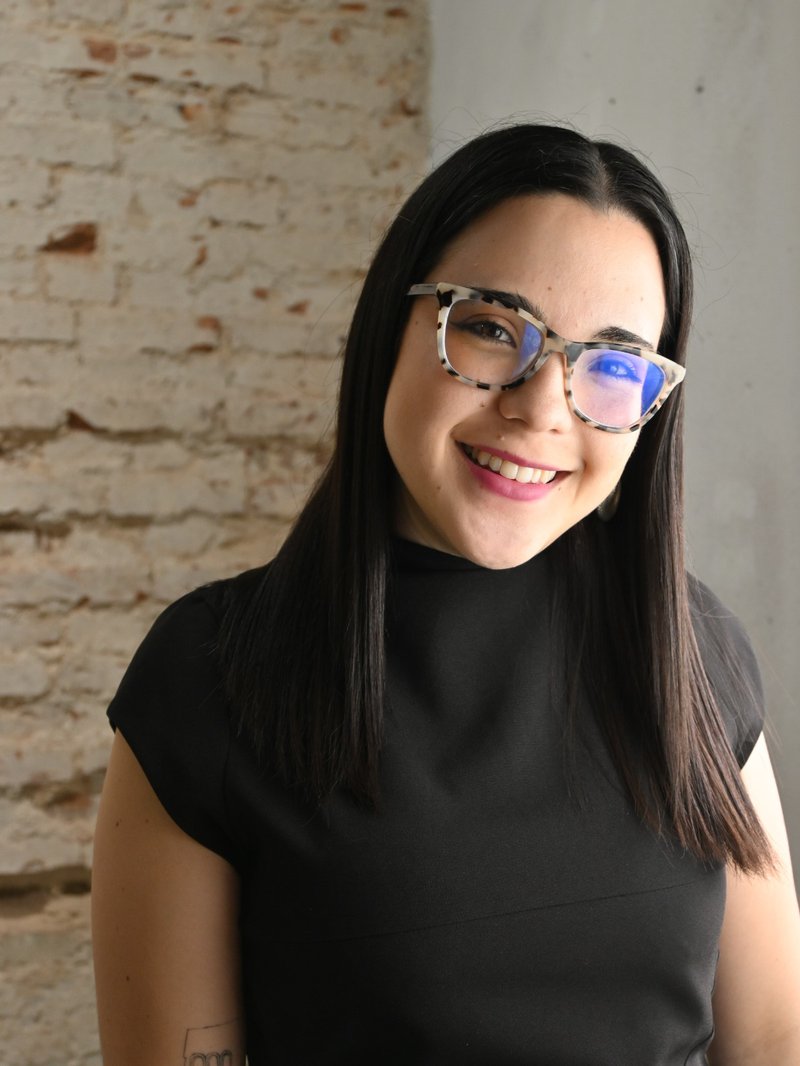
Jimena Galán (1997) is a Guatemalan feminist curator and researcher whose work engages with art as a tool to interrogate memory, power, and social transformation. Her curatorial practice is grounded in the conviction that art is not only a space of representation, but a critical means to document, contest, and reimagine social realities. She works from a situated, feminist, and historiographic perspective, deeply inspired by the writings of Andrea Giunta, to question dominant narratives and recognize the cultural production and agency of those historically marginalized or rendered invisible.
As co-founder of La Revuelta, a feminist collective developing context-sensitive methodologies for formative processes with women and dissident communities, she focuses on creating pedagogical and curatorial spaces that respond to specific territorial, social, and embodied realities. Over the past five years, she has co-curated exhibitions grounded in accessible archives and collective enunciation of social demands, while fostering care, autonomy, and the acknowledgment of diverse knowledge systems and practices. Her work centers collective authorship, ethical documentation, and everyday practices of care as foundations for cultural labor that honors the dignity, knowledge, and agency of its participants.
Currently, she serves as cultural manager at Amano Casa, a platform dedicated to process-based and context-responsive artistic practices, and as a member of the production team for the Bienal en Resistencia. In both spaces, she works through community-centered curatorial methodologies grounded in horizontal dialogue with artists, activists, and theorists. Her curatorial practice focuses on accompanying emerging artists as they consolidate their narratives and archives rooted in political and territorial contexts. By engaging public space and drawing on everyday elements that hold meaning for local communities, she fosters new ways of activating art as a site of critical reflection and collective agency.
Jimena Galán, Curator and Feminist Cultural Worker at La Revuelta in Guatemala City, Guatemala, has been awarded by Teresa Bulgheroni.