The Palestinian Museum
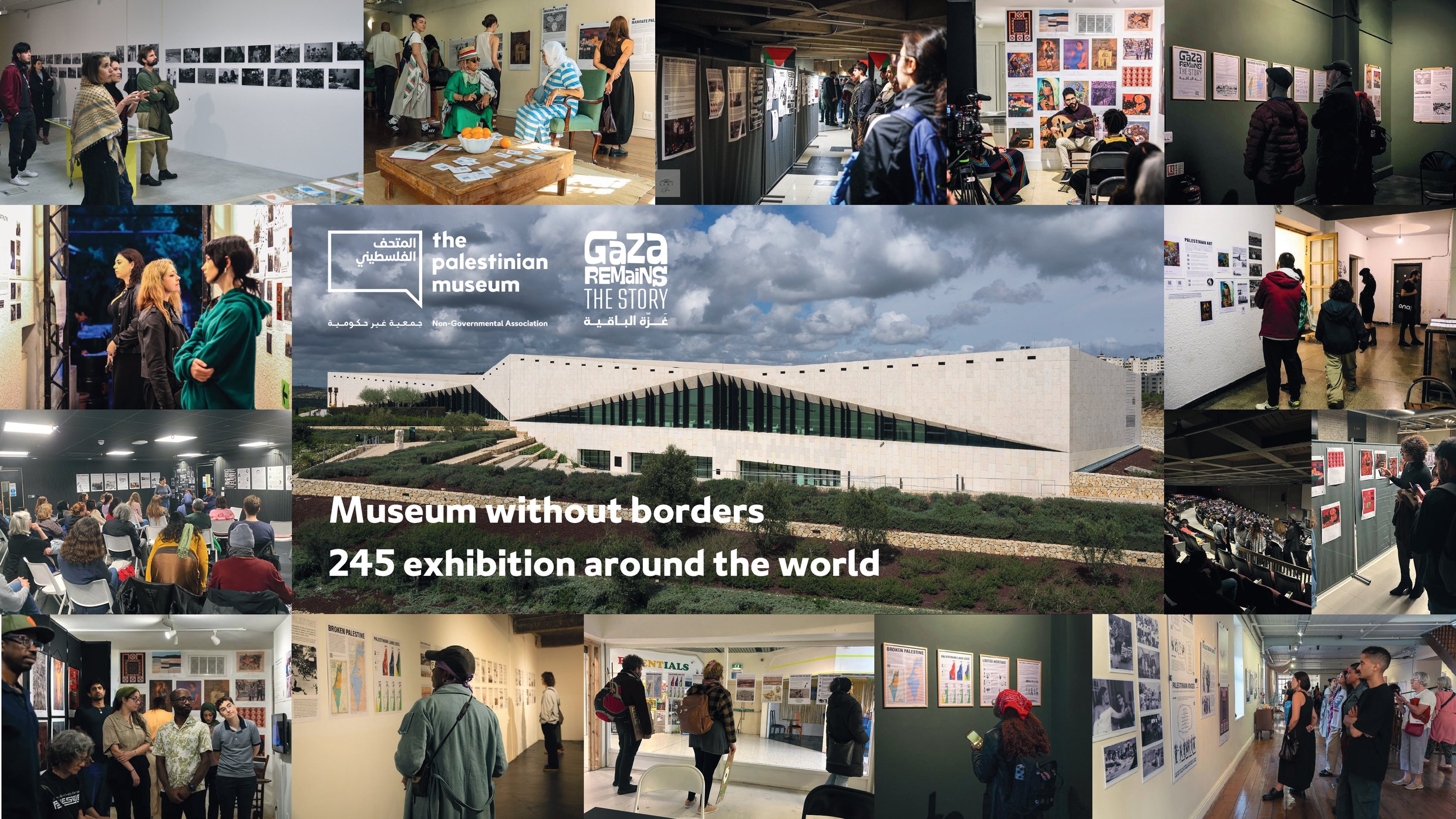
The Palestinian Museum is a non-governmental association dedicated to supporting an open and vibrant Palestinian culture locally and internationally. The Museum presents and contributes to narratives on Palestinian history, culture and society from new and critical perspectives. It also offers spaces for creative ventures, educational programmes, and innovative research. The Museum is a Swiss-registered non-governmental association with a branch in Palestine. Its mission is to produce and disseminate emancipatory learning experiences about Palestine, its people and history through innovative exhibitions and programming, locally and internationally and to transcend political and geographical borders by seeking to form a link between Palestinians in Palestine and abroad through its digital archives and online platforms.
Birzeit, Palestine.
Name of the Practice Nominated: Gaza Remains the Story
Describe the practice, program, or project, what innovative approach is proposed, and in which core museum activities it applies:
In October 2023, three weeks into Israel's bombardment of Gaza, the Palestinian Museum responded swiftly as Gaza's cultural infrastructure was destroyed: two museums, galleries, archives, and heritage sites were reduced to rubble. The Museum offered its main exhibition hall as an extension of bombed Gazan venues, beginning "This Is Not an Exhibition," a collective show for artists created under siege. With no shipping options and limited communication, curating became a radical act. Following scattered messages from Gaza, the Museum tracked down over 330 artworks by 130+ Gazan artists from private homes, universities, and institutions across historic Palestine, partnering with 60+ lenders. Among participating artists were six killed along with their families, their studios flattened—in many cases, these exhibited works are the only surviving proof of their existence.
From this emergency collection, the Museum created "Gaza Remains the Story," a downloadable exhibition featuring 44 experience boards, 33 Palestinian paintings, 66 archival photos, plus QR codes linking to videos and podcasts. This innovative practice transforms crisis response into sustainable cultural stewardship by democratizing access through open-source distribution.
The practice addresses core museum activities: collection through emergency documentation and digitization; exhibition programs via portable, scalable formats; education through comprehensive Gaza narratives; accessibility by removing geographical barriers; research documenting cultural practices under siege; and sustainability through resource-efficient replication.
Launched September 2024, "Gaza Remains the Story" achieved 245 exhibitions across 48 countries, demonstrating how museums can multiply impact through community empowerment. The practice challenges institutional boundaries, enabling universities, solidarity groups, and individuals to become cultural stewards, creating a global network preserving Palestinian heritage during cultural genocide while redefining museology under colonial violence.
Explain in one sentence why you think the project you nominate is outstanding and could serve as an example for the entire community of modern and contemporary art museums.
"Gaza Remains the Story" has created and tested a new model for cultural preservation and dissemination that demonstrates how museums can transcend physical and political boundaries through innovative open-source exhibition models that democratize cultural access while creating unprecedented global solidarity networks for heritage preservation during every increasing crises.
Explain why this practice or program is relevant and sustainable in creating meaningful and lasting connections with people, communities, and the museum context with a medium to long-term vision. (Max 150 words)
This practice creates lasting connections by transforming passive audiences into active cultural stewards through its participatory model. The downloadable format ensures permanent accessibility regardless of political restrictions or resource limitations, making it inherently sustainable. The exhibition's 30% solidarity group participation demonstrates deep community engagement that extends beyond traditional museum audiences.
The medium-term vision encompasses building a global network of cultural allies who continue sharing Palestinian narratives independently. The practice's sustainability lies in its minimal resource requirements—once created, it perpetuates itself through user networks. Long-term impact includes establishing new precedents for crisis-responsive museum work and diaspora engagement.
The initiative creates meaningful connections by addressing universal themes of resilience, cultural preservation, and human dignity while providing specific historical context. Its relevance extends beyond Palestinian culture to demonstrate how museums can respond to contemporary humanitarian crises through innovative, scalable practices that honor both local specificity and global solidarity.
What are the outcomes of the practice you are most proud of?
The most remarkable outcome is the exhibition's unprecedented global reach—245 exhibitions across 48 countries, achieving 6.1 million views and 147,000 social media interactions. This demonstrates the power of accessible, community-driven cultural programming.
Particularly meaningful is the diverse ecosystem of partners: 27.5% solidarity groups, 20.3% organizations, 18.8% individuals, and 13.5% universities, showing how the practice transcends traditional institutional boundaries to create grassroots cultural networks.
The exhibition successfully preserved and shared critical cultural heritage during an active humanitarian crisis, ensuring stories remain accessible when physical cultural sites face destruction. The initiative documented oral histories, traditional practices like Dabkeh dance, and contemporary artistic responses to ongoing challenges.
Most significantly, the practice transformed participants from passive viewers into active cultural advocates, with many organizing related programming, discussions, and solidarity events, creating ripple effects that extend far beyond the original exhibition scope and demonstrating sustainable community engagement.
How has the nominated practice changed your methods and ways of working?
This practice fundamentally shifts the standard approach from centralized, institution-based programming to distributed, community-empowered cultural stewardship. The open-source model required to do so required developing new frameworks for quality control, community support, and impact measurement across decentralized venues. This requires protocol for designing modular, culturally sensitive content that maintains integrity across diverse contexts while allowing for local adaptation. This included creating comprehensive toolkits, hosting virtual training sessions, and developing multilingual support materials.
This case proves that museums can multiply their impact exponentially by empowering others to become cultural stewards rather than maintaining exclusive control over exhibitions. This shift from gatekeeping to facilitation represents a fundamental reimagining of museum practice that prioritizes accessibility, community agency, and crisis-responsive cultural work over traditional institutional boundaries and hierarchies.