Who's Who at CIMAM with Katerina Gregos
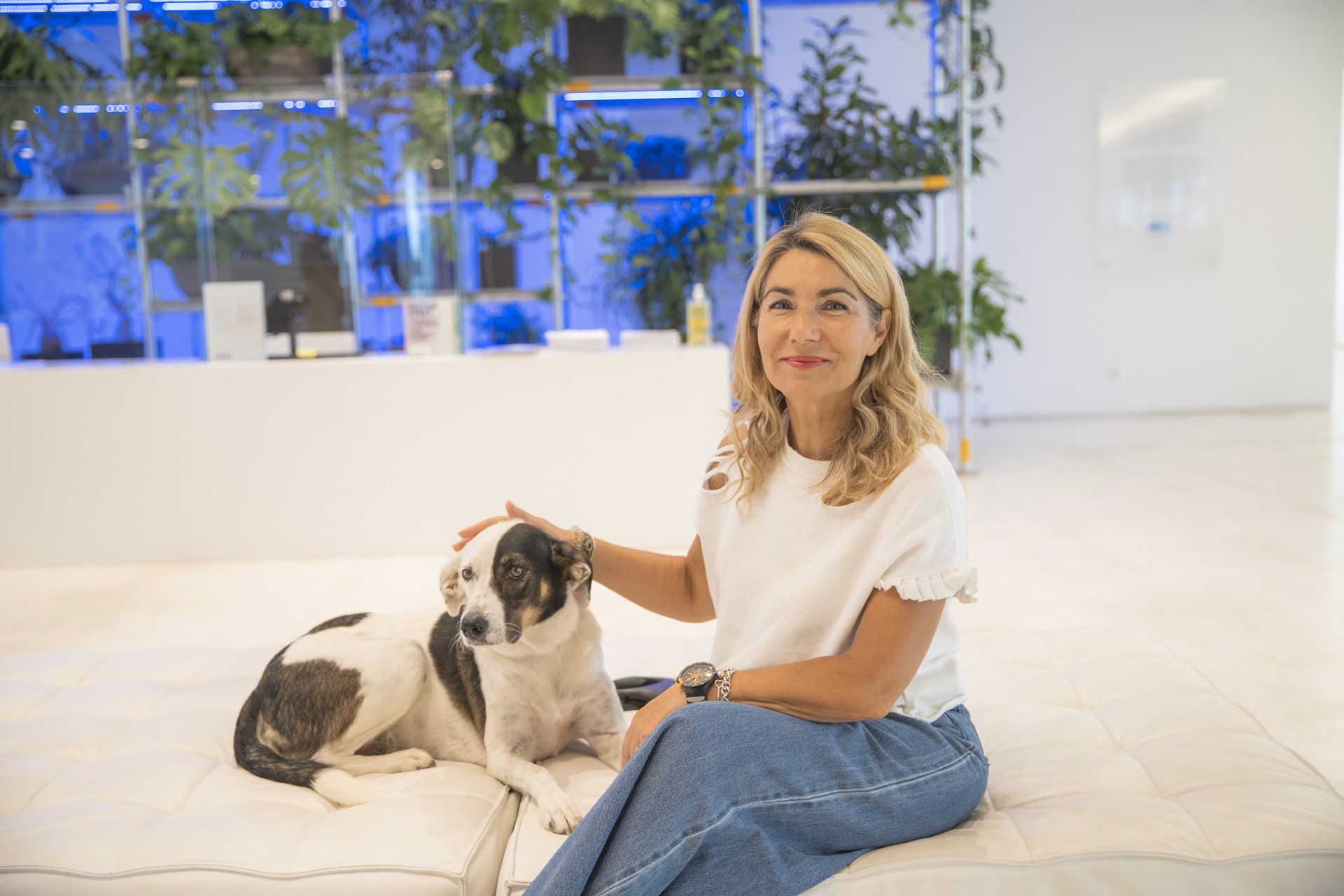
Interview with Katerina Gregos, CIMAM member and Artistic – General Director, ΕΜΣΤ, the National Museum of Contemporary Art, Athens, on receiving the 2025 Nancy Regan Arts Prize for Why Look at Animals? A Case for the Rights of Non-Human Lives.
Since entering full operation just five years ago, the National Museum of Contemporary Art, Athens (EMΣΤ) has rapidly established itself as a significant voice within the international contemporary art landscape.
EMΣΤ’s exhibitions have repeatedly featured in influential critical rankings. Modern Love: Love in the Age of Cold Intimacies was selected by Hyperallergic as one of the Top 50 Exhibitions of 2023, ranking third globally, alongside landmark presentations such as Vermeer at the Rijksmuseum. In 2024, Frieze included Danai Anesiadou’s dPossessions among its Top 10 Exhibitions in Europe, while Artforum highlighted Penny Siopis’ exhibition within the same year. Additionally, Why Look at Animals? was listed among Art in America’s most-read stories, underscoring the exhibition’s resonance with broad international audiences.
First of all, congratulations, Katerina, on receiving the 2025 Nancy Regan Arts Prize for Why Look at Animals? A Case for the Rights of Non-Human Lives. Could you tell us what led you to conceive this exhibition and what motivated you to address the complex relationships between humans and non-human life?
Thank you very much. I’m deeply honoured to receive the Nancy Regan Arts Prize. The award committee’s recognition that the “focus, scale, and scope of the exhibition is unprecedented in the art world” makes this distinction particularly meaningful, as it affirms the urgency and ambition behind the project. Why Look at Animals? A Case for the Rights of Non-Human Lives grew from a long-standing concern about how profoundly disconnected we have become from the natural world, and from the other species with whom we share this planet. The idea took root in my rereading of John Berger’s 1980 essay Why Look at Animals?, which remains astonishingly prescient. Berger described how animals, once central to human existence, as symbols, companions, and sources of meaning, have gradually disappeared from our daily lives, surviving only as abstractions: images, commodities, or spectacles. His observation felt increasingly urgent in our current moment of ecological crisis and moral reckoning. I wanted to create an exhibition that did more than simply explore animals as a motif in art history. I wanted to confront the ethical and philosophical implications of how we treat non-human life, to challenge speciesism and to consider animals as what we know they are: sentient beings with intelligence, emotion, and agency. For me, this is inseparable from broader conversations about ecological justice and coexistence. We live in an era when humans have radically altered the planet’s ecosystems. To continue believing that we stand outside or above the rest of nature is both arrogant and dangerous. The exhibition is an attempt to reframe that narrative, to ask viewers to see animals not as ‘others’, but as cohabitants in a shared, fragile world.
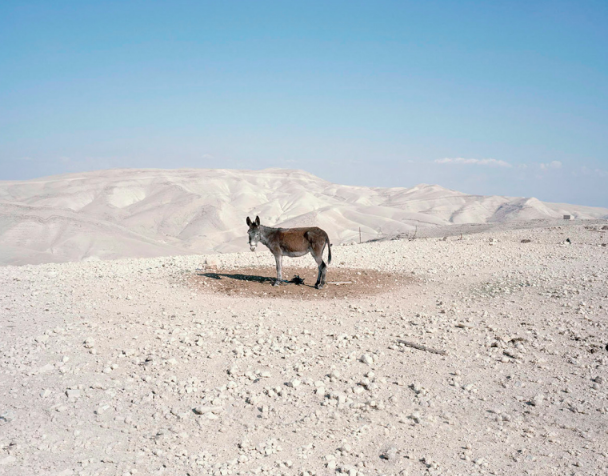
The exhibition at EMST is an ambitious undertaking that brings together over sixty artists from across the world. Could you share more about how you approached the curatorial process, the selection of artists, and how their contributions articulate the broader ethical and philosophical dimensions of the exhibition?
From the outset, I wanted Why Look at Animals? to be both a poetic and philosophical journey; not just an exhibition about the condition of animals and their plight at the hands of humans (although it is that, too), but a space that interrogates our shared existence and the moral questions that arise from it. The curatorial process was as much about empathy, learning, and listening as it was about scholarship. I wanted to bring together artists whose work has engaged deeply with and expands our understanding of what it means to coexist, emotionally, ethically, and ecologically, with non-human life. The selection of artists followed four guiding threads. First, to foreground practices that recognise animals as sentient beings, with intelligence, interiority, and agency. Second, to amplify non-Western, Indigenous, and postcolonial perspectives that resist anthropocentric thinking. Third, to reflect on the entanglement between ecology, economy, and power through artists whose works dismantle the hierarchies that separate human from animal, nature from culture. And fourth to highlight new forms of knowledge about non-human life and to imagine alternative futures of mutual co-existence and inter-species equilibrium. Together, the more than 60 others in the exhibition articulate a chorus of perspectives that spans more than thirty countries and multiple cosmologies. Some works mourn extinction; others imagine new modes of coexistence. All insist that our ethical responsibilities extend beyond the human realm. Ultimately, my curatorial approach was to construct a dialogue, a living ecology of voices rather than a singular argument. The exhibition invites viewers to pause, to think differently, and to reconsider what it means to live justly alongside other forms of life on this fragile planet. Finally, it aims to awaken awareness of the vast and ongoing plight of non-human life today – one of the most urgent yet skillfully obscured and systematically repressed issues in the public sphere – and to confront our complicity in perpetuating systems of control, exploitation and violence (on a massive scale) against our fellow non-human co-inhabitants on this planet.
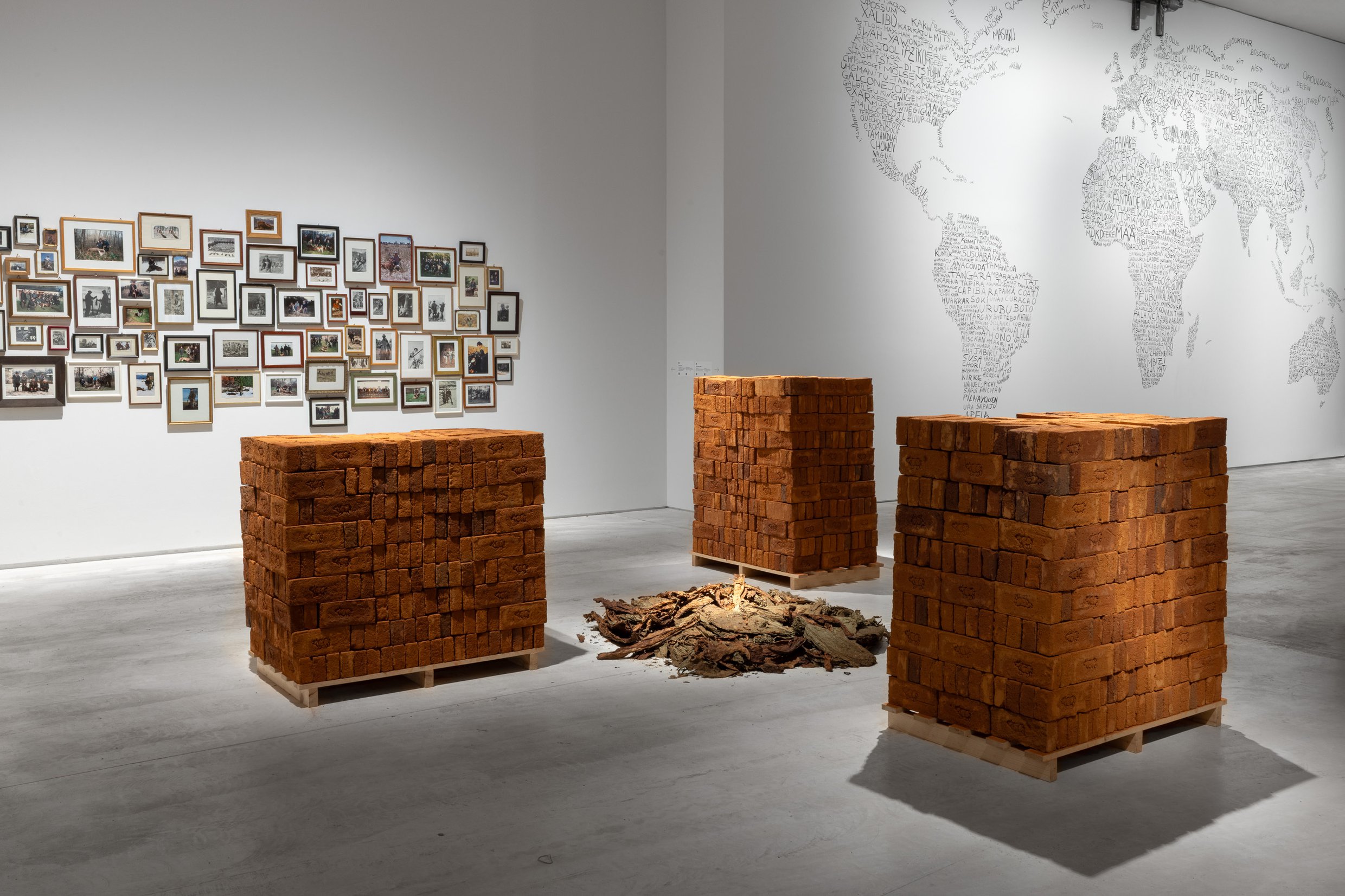
Installation view (from left to right):
Mark Dion, Men and Game, 1998. Courtesy of the artist and Tanya Bonakdar Gallery, New York, Los Angeles | Rossella Biscotti, Clara, 2016. Courtesy of the artist | Art Orienté Objet, L’Alalie, 2010. Courtesy of the artists. Photo: Paris Tavitian
In your curatorial statement, you write that “it is an ethical imperative to re-examine our relationship with non-human beings with whom we cohabit the Earth.” This resonates strongly with current discourses around the climate crisis and sustainability. How do you see the role of contemporary art - and museums in particular - in shaping this urgent rethinking of our place within the natural world?
I believe that one of the most urgent responsibilities of contemporary art, and of public museums (as ΕΜΣΤ is) as civic institutions, is to expand our moral imagination. The ecological crisis is not only a political or scientific issue; it is also a crisis of perception, empathy, and values. We have reached a point where the way we see the world and nature, as something to be used, owned, and controlled, is no longer sustainable. Art, with its ability to foster critical reflection and emotional resonance, can help us discard these inherited hierarchies and imagine new forms of coexistence. When I wrote that it is an ethical imperative to re-examine our relationship with non-human beings, I meant that this rethinking must begin at the level of culture and education, at the level of how we tell stories about the world and our place within it. Museums are uniquely positioned to be catalysts for this shift. They can move beyond preservation and display to become spaces for dialogue, questioning, and concern for the worlds around us. At EMΣT, we see the museum as a space that responds to the urgencies of our time but also of the place/space we inhabit. Exhibitions like Why Look at Animals? are part of a broader institutional commitment to address the entanglement of ecology, ethics, and politics. We aim to make visible the interconnectedness of all life forms and to create a platform where art can articulate the emotional and moral dimensions of the climate crisis, beyond the language of statistics and policy. Ultimately, I see art’s role as both forward-thinking and reparative, among other things: to reveal the damage we have done, but also to help us imagine how we might live differently. In a world that urgently needs new narratives of empathy and stewardship (of nature and of ‘Others’), museums can be laboratories for rethinking what coexistence – and justice – might look like across species.
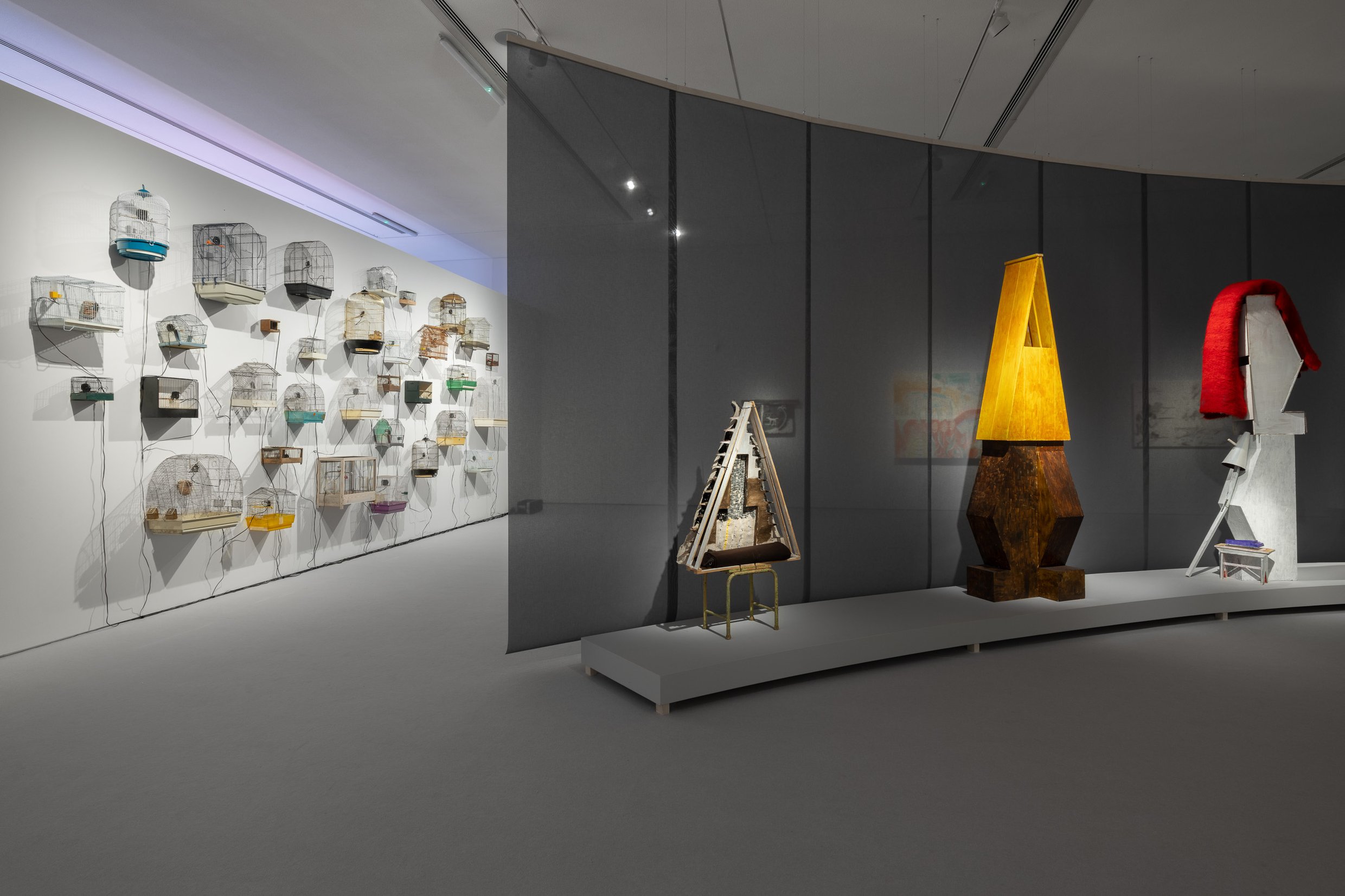
Installation view (from left to right):
Oussama Tabti, Homo-Carduelis, 2022. Collection of EMΣT | Kostis Velonis, Woodstock's Wind & Waves Sailing Club, 2024; Woodstock’s Birdhouse, 2024-2025; Schroeder’s auditorium and Linus’ Roof for Woodstock’s Venue, 2025. Courtesy of the artist. Photo: Paris Tavitian
Your career spans major institutions, biennials, and independent projects across Europe, from the Deste Foundation in Athens to Argos in Brussels, and now EMΣT. How have these experiences informed your curatorial practice and your vision of what museums can and should be today?
Each chapter of my professional trajectory has shaped how I understand the museum; despite the challenges they face today, they still remain the most appropriate institutional space in the field of culture for civic engagement and critical reflection as they operate in the «longue durée», to borrow the historical term coined by Fernand Braudel. Working across such different contexts – from the (private) Deste Foundation in Athens to (the public) Argos in Brussels, and later several biennials – has taught me that art is at its most potent in the space of the museum precisely because of its capacity for continuity but also renegotiation, self-criticality and re-negotiation. Museums, at their best, can function as laboratories for civic dialogue and as spaces for the production of vital knowledge in addition to being guardians of artworks and cultures. At EMΣT, these experiences converge into a vision of the museum as a civic, ethical space – one that is open, globally connected, and deeply grounded in local realities. I see the museum as a forum for public thought: a place where the urgent questions of our time, from democracy and inequality to the climate crisis and the rights of non-human life, can be explored through art’s unique language of complexity, emotion, and imagination. In that sense, my curatorial practice has always been guided by the same conviction: that museums should not simply preserve culture, but participate in shaping it, not as monuments to the past, but as engines of possibility.
You have also curated nine international biennials, including three national pavilions at the Venice Biennale for Denmark (2011), Belgium (2015), and Croatia (2019). What key lessons or good practices have you taken from these experiences that you believe remain relevant for curators working today?
Working on biennials and national pavilions in Venice has been transformative because they are at once hyper-local and profoundly global. Each one is an encounter with a specific political, social, and historical context, and a reminder that curating is not about imposing a vision, but about listening deeply to the place and its artists. When I curated Denmark’s pavilion in 2011, Speech Matters, which was an international group exhibition, it was in the midst of growing xenophobia and nationalism across Europe. The exhibition explored freedom of speech and its limits, themes that, sadly, remain just as relevant today. For Belgium in 2015, together with the artist Vincent Meessen, we invited a group of artists for Personne et les autres, a project about colonial legacies and the construction of national identity. Like the Danish Pavilion, it challenged the very idea of a “national” pavilion (especially one that was inaugurated during the brutal colonial regime of King Leopold II in Congo). And for Croatia in 2019, I worked with Igor Grubić on Traces of Disappearing (In Three Acts), a decade-long project examining Croatia’s post-war transformation from socialism to capitalism. Across all these projects, the key lesson has been that curating – to me – is as much about ethics as it is about aesthetics. It’s about creating conditions for artists to speak to the urgencies and concerns of their time, while maintaining their creative curiosity, intellectual clarity, and independence. The best exhibitions, I believe, do not simply illustrate ideas; they test them. They hold a mirror to society while imagining something different. For curators today, that means embracing complexity and nuance while remembering that art’s most enduring power lies in its capacity to make us see, feel and think at once.
You also served as a member of the CIMAM Board. Could you share a reflection on that period—what it meant to be part of CIMAM’s leadership—and how you continue to connect with the organization today?
Serving on the Board of CIMAM in the early 2000s was both a privilege and a formative experience. I was very young and my fellow board members (Alfred Pacquement then at Centre Pompidou, Glenn Lowry then at MoMA, Anton Herbert, the now deceased legendary collector, David Elliott, then director of Mori Art Museum, and Sheena Wagstaff, then at Tate, and Yuko Hasegawa, Founding Artistic Director of the 21st Century Museum of Contemporary Art, Kanazawa), were older and much more seasoned than me. I learned a lot. It offered a unique vantage point from which to reflect on the global ecology of museums and to engage with peers committed to ensuring best practices in the field, valuable knowledge which stayed with me for years.
It was inspiring to witness how colleagues from institutions at very different stages of development could learn from one another, exchange best practices, and stand together in defence of artistic freedom. That sense of collegiality continues to inform how I lead EMΣT today. I remain connected to CIMAM’s mission, as both a participant and an advocate, because I believe museums must work collectively to redefine their social contract. We cannot isolate ourselves within national frameworks; our challenges are global, and our responses must be collaborative, ethical, and imaginative. In that sense CIMAM is much more than a professional network, it is most of all a space through which to exchange ideas, develop best practices, and address shared challenges. It is very rewarding to also see how the organisation has evolved and diversified over the years through initiatives like the online conferences, which offer valuable opportunities for knowledge exchange without the cost of travelling.
How do you see the present and future of museums in their mission to promote diverse, equitable, and inclusive artistic production; to foster education and accessibility within their communities; and to remain relevant, trusted institutions that serve as models of good practice? And in this context, how do you think CIMAM can help preserve and strengthen this mission, reinforcing the role of museums as key contributors to the cultural and social development of our societies?
Museums today face a profound reckoning, not only about what and whom they represent, but about how they operate, who they serve, and what kind of futures they imagine. For me, in order for the museum of the 21st century to remain relevant, it must be a civic, inclusive space, one which both renegotiates history and addresses historical biases and inequalities but also a place which promotes new forms of vital knowledge in addition to new cultural and artistic forms of expression. It should actively promote diversity and equity not as checklists or slogans, but as embedded institutional values that shape its governance, programming, and working culture. At EMΣT, our approach is to ensure that inclusion begins from within: through fair pay for artists and collaborators, through gender parity in the series of exhibitions What if women ruled the world?, and through sustained support for younger and underrepresented voices from Greece, the Greek diaspora, and the broader Mediterranean region. Accessibility, for us, also means intellectual, bodily but also emotional accessibility, through exhibitions and public programmes that invite curiosity and empathy. We also welcome animals! We’re one of few art institutions in the world where pets can visit with their owners. Also, ΕMΣΤ is accessible for disabled people and was one of the first museums in Europe to offer access for those with sensory impairments. Today, a museum should be a place where the care for artworks, artists and exhibitions needs to coexist with critical thought, imagination and practices of hospitality and care for everyone involved. I believe museums must reclaim their role as trusted civic institutions. In an age of disinformation and polarisation, the museum can model integrity, transparency, and true multi-faceted dialogue, qualities that are as important as artistic creativity. To remain relevant, museums must engage with the urgencies of their time: the climate crisis, social justice, human and non-human animal rights, decolonisation, and the redefinition of the commons. They should be laboratories for rethinking values, not simply temples of authority. In this evolving landscape, CIMAM plays a vital role as a global platform of connectedness and knowledge exchange. Its advocacy work offers museums the framework needed to navigate political pressure, financial precarity, and institutional transformation. CIMAM’s strength lies in its ability to connect colleagues across borders and to promote best practices that safeguard professional integrity. Ultimately, the future of museums will depend on our capacity to collaborate, to share knowledge, to listen to different perspectives, and to build institutions that reflect the complexity and diversity of the societies they serve. In that sense, CIMAM is not just an organisation; it is a moral compass for our field, reminding us that art and ethics must move forward together.
Which of CIMAM’s resources or programs do you most often engage with or find valuable in your professional work?
CIMAM’s resources are invaluable because they combine practical guidance with a deep ethical foundation, something every museum professional needs today. I often draw on the Toolkit for Environmental Museum Practices, which offers a clear, evolving framework for sustainability. It’s an excellent reminder that change is not only about large gestures but about continuous, mindful adjustments in how we curate, produce, and care for artworks and audiences. I also find Museum Watch to be one of CIMAM’s most important initiatives. It provides a vital advocacy mechanism for institutions and individuals facing censorship, political pressure, or governance issues, challenges that are becoming increasingly widespread. Knowing that there is a network ready to speak up collectively when professional integrity or artistic freedom is threatened gives courage and reassurance to museum leaders everywhere. Finally, the Annual Conference remains a highlight. It’s one of the few truly global spaces where one can engage in open, rigorous dialogue with peers from all regions. For me, CIMAM’s strength lies in precisely this: creating a sense of shared purpose and mutual accountability among museum professionals working to keep our institutions transparent, inclusive, and future-oriented.