Sternberg Press joins CIMAM’s Editorial Partnership Program
CIMAM is delighted to announce a new collaboration with Sternberg Press, the London-based publishing house of art and cultural criticism, creative nonfiction, and literary and experimental fiction. As part of this partnership, CIMAM members will enjoy a 20% discount on titles purchased through Sternberg Press’s webshop.
CIMAM Members: Access this benefit in the Members Only section under Editorial Discounts.
To inaugurate this collaboration, we are pleased to highlight Sternberg Press’s The Contemporary Condition series as the first titles in this special collaboration with CIMAM members.
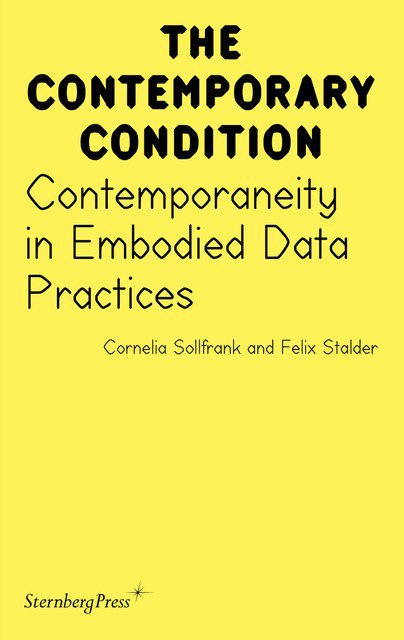
The Contemporary Condition series offers a sustained inquiry into contemporaneity as a defining condition of our historical present. Departing from the assumption that the relationship between artistic practice and sociopolitical reality is radically changing, the series explores planetarity, the aesthetics of eco-systemic changes, and how the networked image can be understood as a relational assemblage to address the politics of infrastructure and wider ecologies. Published in partnership with the Centre for Research in Artistic Practice under Contemporary Conditions at Aarhus University, 2025 saw the release of the 20th volume in this popular series. Looking back to the first volume, series editors Geoff Cox and Jacob Lund provide the following introduction to their approach:
Our scope [...] is wide and our approach unashamedly eclectic. Approaching the question, phenomenon, idea, or fiction even, of contemporaneity seems to force us into bringing together different epistemological registers that are not usually brought into dialogue and that do not easily communicate with each other. It is, however, our belief that it is necessary to break the confines of these registers and disciplines in order to grasp contemporaneity and its possible consequences. This is because contemporaneity cannot be limited to a certain feeling or relation to time, to a historical period, to a particular development in technology, to a phase of capitalism, to whatever is present at the same time, and so on. It has a number of different dimensions and aspects to it, which are not mutually exclusive. In our endeavor not to merely consider contemporaneity as a matter of fact, but rather turn it into a matter of concern (to borrow a formulation from Bruno Latour), it may seem to some readers that we are drawing together too many competing discourses and epistemological registers. But it seems to us that this kind of messy interdisciplinary inquiry is perfectly suited to its object of study that already draws from divergent spatial and temporal axes. The concept of contemporaneity refers to temporal complexity on many different scales, ranging from the individual to the collective, from the local and microcosmic to the global and the planetary. We would therefore argue for a transversal approach that aims to embrace the ways that different lines of enquiry intersect in topological structures that suggest recombinatory possibilities and reappropriations of space and time. This may or not be good scholarship but more to the point it allows for a coming together of concepts and ideas that break from traditional hierarchizations and conceptual paradigms and instead introduces inventive forms of assembling meaning that oscillate between the registers of the human subject, media, and culture. Together these form a transversal framework for establishing intersections of different lines of enquiry and methodologies that we utilize in [...] the book series [...]—to open up a further diversity of perspectives, including a more planetary one which necessitates a slowing down and deepening of time. The point however is not to agree to any kind of settlement of these axes but to recognize that they converge and diverge and as such produce dynamic tensions and slippages of meaning.
Geoff Cox and Jacob Lund, The Contemporary Condition: Introductory Thoughts on Contemporaneity and Contemporary Art (Sternberg Press, 2016), 22-23.