Kala Hubba Festival
CIMAM shares with its international community the BLR Hubba Festival, a citywide cultural celebration taking place in Bengaluru from 16 to 25 January 2026. Spanning ten days, the festival brings together more than 250 events across 12 diverse genres, transforming the city into an open platform for artistic exchange, participation, and public engagement.
Conceived as a radically inclusive cultural programme, BLR Hubba offers audiences the freedom to navigate the festival according to their own interests. As chief facilitator V. Ravichandar explains, the festival’s structure—divided into multiple thematic “hubbas”—aims to reflect the diversity of Bangalore’s cultural ecosystem. Among them are Kala Hubba (visual arts), Kantha Hubba (music), Anubhava Hubba (immersive and interactive experiences), and Makkala Hubba, dedicated to children.
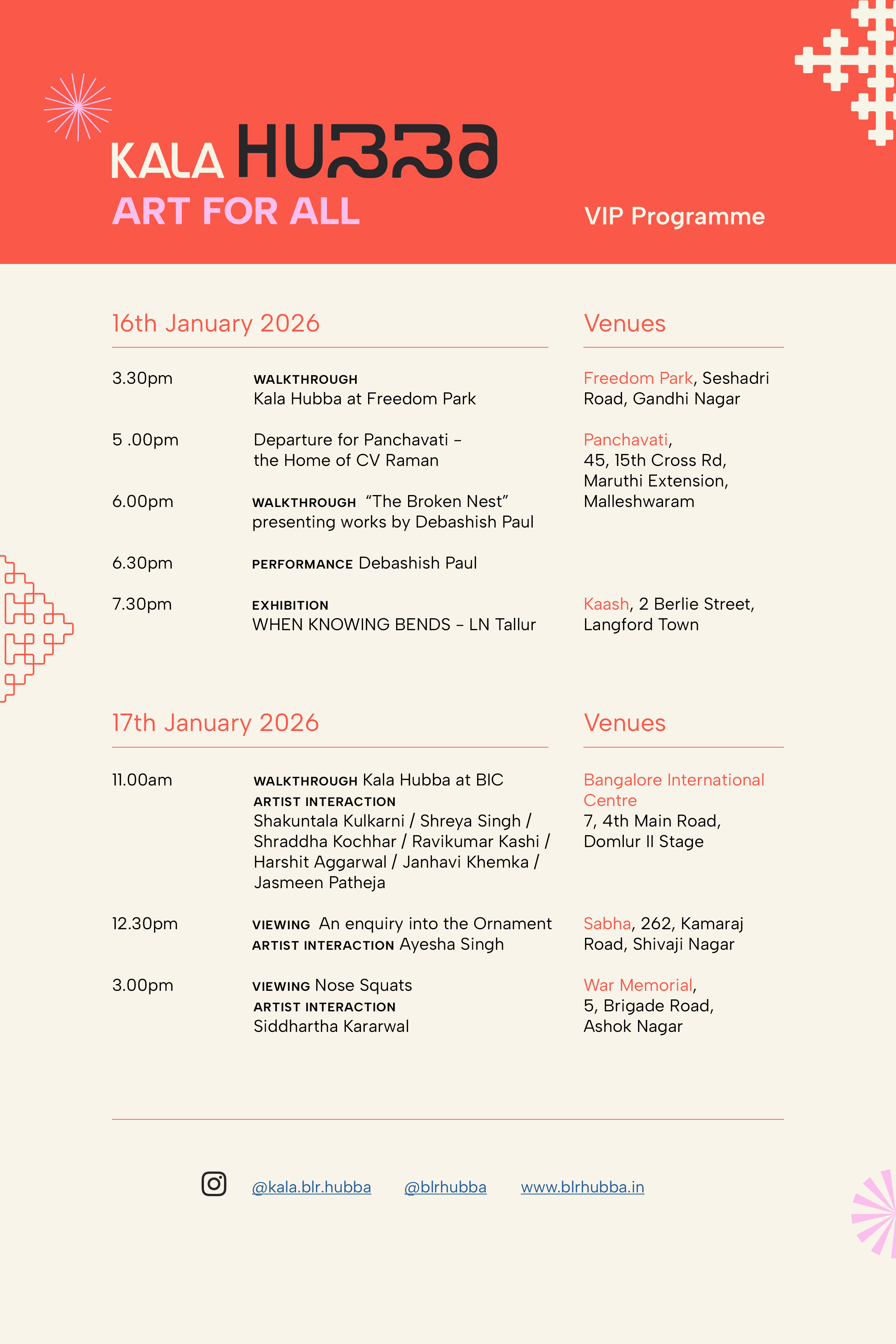
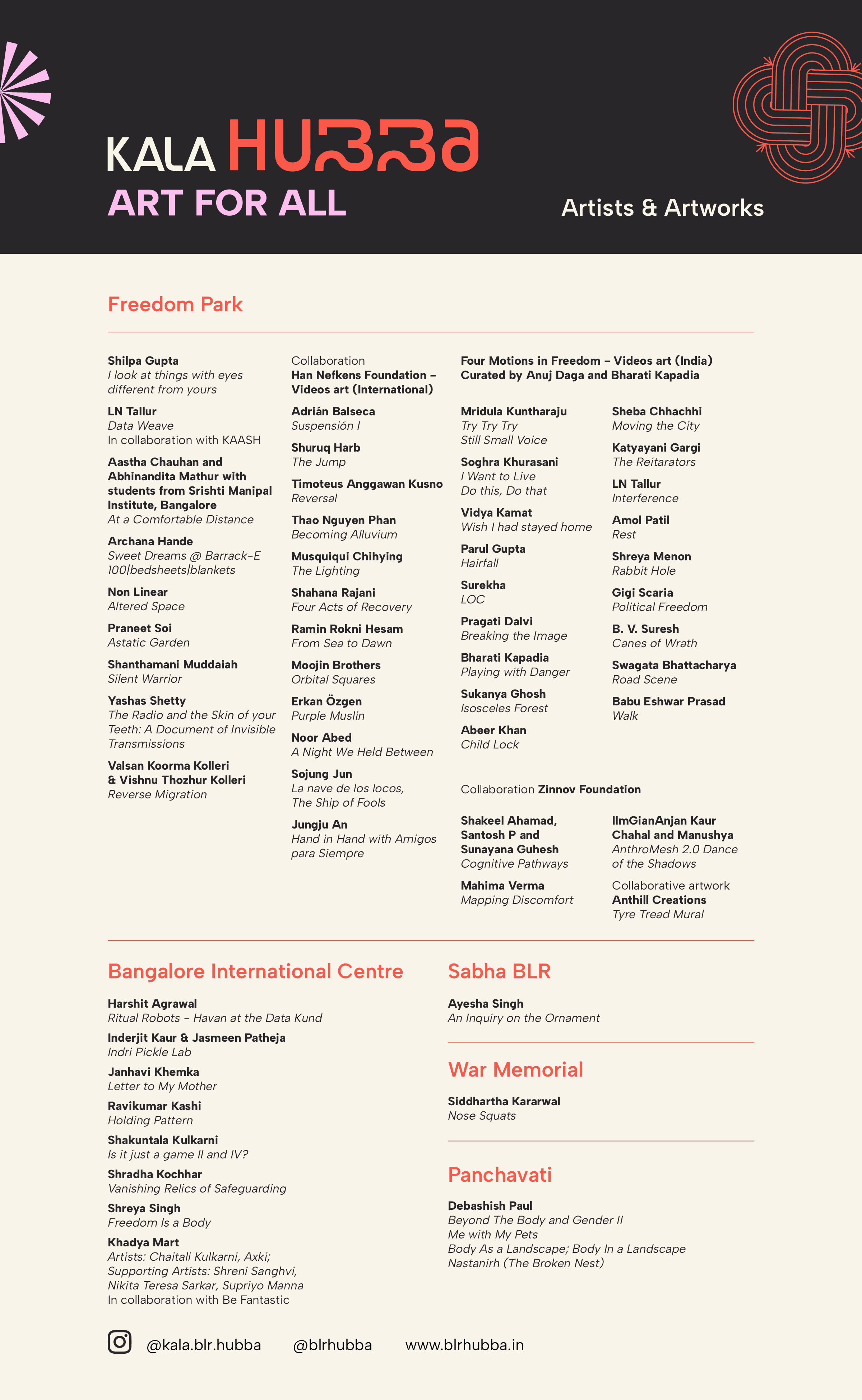
CIMAM is pleased to highlight Kala Hubba, the visual arts programme curated by Kamini Sawhney, who is also a member of the CIMAM Board. Kala Hubba presents 58 commissioned works, most of them newly commissioned—including installations, sculptures, and video art—by Indian and international artists, installed across key sites in the city such as Freedom Park, the Bangalore International Centre (BIC), Panchavati (the historic home of Nobel laureate Sir C.V. Raman), and Sabha. An international video section is presented in collaboration with Han Nefkens Foundation, featuring 12 films commissioned by them.
At the heart of Kala Hubba is a strong commitment to public art. For Sawhney, this approach reflects a fundamental conviction: art is a right, not a privilege. Rather than asking audiences to enter institutional spaces, the project reverses the relationship by embedding art within the everyday spaces of the city. In doing so, it invites artists to respond directly to social contexts, lived experiences, and the needs of diverse publics.
The overarching theme of freedom emerged organically from Freedom Park itself—a former prison complex that has since become the city’s primary site for public protest.
Through site-specific works and multiple perspectives, Kala Hubba—and the wider BLR Hubba Festival—positions art as a catalyst for dialogue, care, and collective imagination. CIMAM invites its members and the broader international museum community to engage with this ambitious festival and to follow its unfolding conversations in Bengaluru over the coming days.
For details and registration, visit www.blrhubba.in.
KALA HUBBA
ART FOR ALL
Curatorial Note
Freedom Begins When We Start to Listen
What do we as citizens yearn for?
Is it liberation?
What do we want to be free from?
Noise? Social constructs? Surveillance?
And what do we seek through our freedom —
a memory, a right, a struggle,
or a promise?
This public art project reimagines freedom by engaging with Bengaluru’s public spaces, beginning with Freedom Park—a site of confinement now reimagined as a place for public protest, leisure, play and so much more, bringing people together across gender, class, language, and religion.
Kala Hubba explores the varied aspects of liberty not only within the personal and political space but also the challenges that freedom brings when advocating for inclusion of gender, body, labour, caste and community. Can art provide spaces of solidarity, care and mental well-being? Can it encourage discussion, debate and urge us out of our inertia?
These are questions that are echoed in the several venues that Kala Hubba activates across the city, initiating conversations, building community, providing a platform for those who struggle to be heard. The artists who are part of this public arts project approach freedom from many perspectives: freedom from marginalisation, from gender discrimination, freedom of speech, freedom of the body and of the mind. Their works span personal, political, and poetic interpretations, asking us to examine our own notions of freedom and whether they accommodate the rights of others.
They remind us that freedom is part of an ongoing negotiation, something that must be protected, expanded, and reimagined. And that is the challenge with freedom: it often raises difficult questions about who defines it, who grants it, and who benefits from it.