Seoul Museum of Art(SeMA)
The Seoul Museum of Art (SeMA) aims to build public memories shared by all users, mediators, and producers and imagine a renewed future by cultivating socio-cultural values. SeMA (referred to as Seoul’s Network Museum) adapts to changes in the times and art trends and grows each day through SeMA’s branch museums situated all over Seoul that reach across and complement one another, inspiring citizens of Korea and beyond.
Name of the practice nominated: 2025 Art Program for All We’re going to the Museum
Describe the practice, program, or project, what innovative approach is proposed, and in which core museum activities it applies:
SeMA’s Art Program for All, We’re going to the Museum (2025), is an experimental project aimed at expanding museum accessibility for both people with and without disabilities. The project began with a collaborative initiative involving disabled and non-disabled participants working alongside artist Missionit (Byungsoo Kim) to co-create a sensory bag tailored for visitors with disabilities.
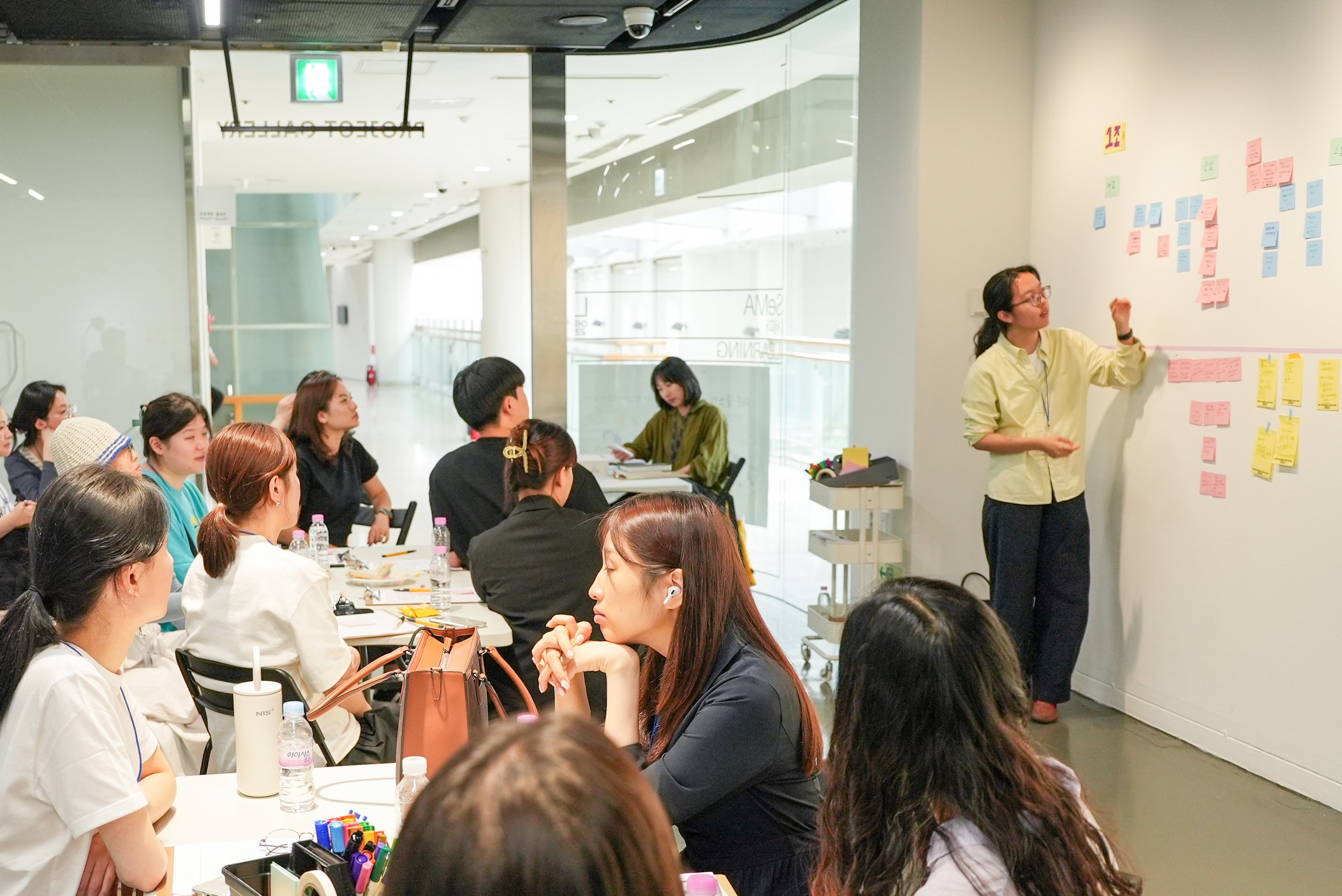
Participants with autism, mental disorders, intellectual disabilities, and visual impairments were paired with non-disabled individuals to tour the exhibition. As they explored, they noted the inconveniences they faced in terms of movement, viewing, and communication, and posted these reflections on one wall of the exhibition space.
Based on these insights, the artist created mock-ups of various tools, including a headset, fidget toys, sensory maps, a museum guide with Braille translation, communication cards, question cards, tactile maps, and bags in different shapes and materials. These were presented in a showcase. Participants exchanged feedback on whether the items were genuinely helpful, what improvements could be made, and whether any of the tools were unintentionally designed with non-disabled users in mind.
Over the course of seven workshops, a central and transformative question emerged: “Do the need for these tools and materials truly differ depending on whether or not one has a disability?” This prompted a critical reflection on the museum’s approach, which had focused on offering ‘hospitality services’ specifically for disabled visitors. As a result, the team created the Discovery Bag for All—a set of viewing tools designed for all visitors, regardless of disability status, including those with different physical, cognitive, and sensory needs (such as children, older adults, and people unfamiliar with museums).
SeMA’s efforts to build a Museum for All take place within the broader framework of the Art Program for All. Sub-projects such as We’re going to the Museum, Easy Read (2022–), and Meet the Museum through the Body (2022–) are interlinked and evolving. Together, they serve as driving forces in actively and concretely advancing key contemporary museum agendas: education, accessibility, inclusiveness, and sustainability.
Explain in one sentence why you think the project you nominate is outstanding and could serve as an example for the entire community of modern and contemporary art museums.
While many contemporary art museums have focused on developing programs from a benefactor’s perspective—aimed at identifying and supporting previously overlooked audiences—this program centered on how those excluded could assert themselves as agents. Through democratic discussions between disabled and non-disabled participants, the project redefined its purpose and direction, ultimately creating a new grammar of hospitality.
Explain why this practice or program is relevant and sustainable in creating meaningful and lasting connections with people, communities, and the museum context with a medium to long-term vision.
Through this practice, SeMA discovered and built relationships with a new community that includes artists with autism or visual impairments, advocacy groups promoting the rights of neurodiverse individuals, cultural columnists with disabilities, special education teachers, NGO staff, social enterprises employing people with disabilities, and welfare institutions supporting independent living for disabled persons. These groups, which had previously had only limited connections with SeMA, participated in seven workshops where they exchanged perspectives and experiences, exploring potential avenues for collaboration with the museum. In the process, they played a crucial role in critically reflecting on and reshaping the discourse around the inclusive museum. They have since positioned themselves as valuable partners capable of continuously contributing new sensibilities and perspectives to the museum’s operations and future programming.
What are the outcomes of the practice you are most proud of?
The most meaningful achievement was that nearly 40 disabled and non-disabled participants built rapport and took part in workshops at least three to four times over two months, collaboratively creating the Discovery Bag for All—a set of viewing tools designed for use by everyone, regardless of disability.
Another notable accomplishment was the sharing session, which drew around 150 attendees who engaged with the project’s production process and outcomes, fostering a shared understanding and helping to spread the meaning and value of inclusive practice. The Discovery Bag for All was not a service delivered by the museum, but a practical outcome actively co-created by the participants. In this way, the concept of “all” was embodied as a living and participatory practice, laying the foundation for an ongoing relationship between the museum and the community, and for a shared pursuit of inclusive direction.
How has the nominated practice changed your methods and ways of working?
The project We’re Going to the Museum, in which participants with and without disabilities served as central agents, brought meaningful changes to the museum’s working methods and perspectives. Although it initially began with a charitable, service-oriented goal of producing sensory bags for disabled visitors, the project evolved through workshops and open discussions into a collaborative effort to reimagine a set of viewing tools accessible to all, regardless of disability.
Through this process, participants also came to realize that commonly used concepts such as accessibility, barrier-free, and inclusivity—though intended to support disabled visitors—could, depending on the context, inadvertently reinforce the binary between disabled and non-disabled people, and objectify disabled individuals.
This experience of actively engaging the community has laid a valuable foundation for deepening SeMA’s inclusive policy direction—not only in planning programs for all, but also in shaping a more inclusive institutional culture moving forward.