Museum of Latin American Art (MOLAA)
The Museum of Latin American Art expands knowledge and appreciation of modern and contemporary Latin American and Latino art through its Collection, ground-breaking Exhibitions, stimulating Educational Programs, and engaging Cultural Events.
Long Beach, California, USA.
Name of the practice nominated: MOLAA Research Center and Laboratory.
Describe the practice, program, or project, what innovative approach is proposed, and in which core museum activities it applies:
To address the systemic issue of low representation of the Hispanic, Latin American, Latinx, Caribbean, and Chicanx experience in the museum field in the USA, the Museum of Latin American Art (MOLAA), located in Long Beach, California, under the direction of the Chief Curator, Gabriela Urtiaga, created and implemented the 2023–2026 Latino Museum Research & Fellowship Consortium (LMRFC) and the MOLAA Collection Research Center and Laboratory, with the support of the Institute of Museum and Library Services (IMLS).
The goals of the project are to promote cross-institutional relationships between and among institutions of higher learning and advance studies relating to American Latino life, art, history, and culture. The project promotes multi-faceted activities and goals that include building a pipeline of paid fellowship opportunities for masters and postdoctoral students; providing resources for professional development opportunities paired with fellowships at MOLAA; fostering research collaboration by leveraging MOLAA’s curatorial staff expertise and over-1,300-object collection of Latin American, Latinx, and Chicanx art; and developing cross-institutional relationships between institutions of higher learning and MOLAA to promote student cohort learning opportunities across universities; among other activities.
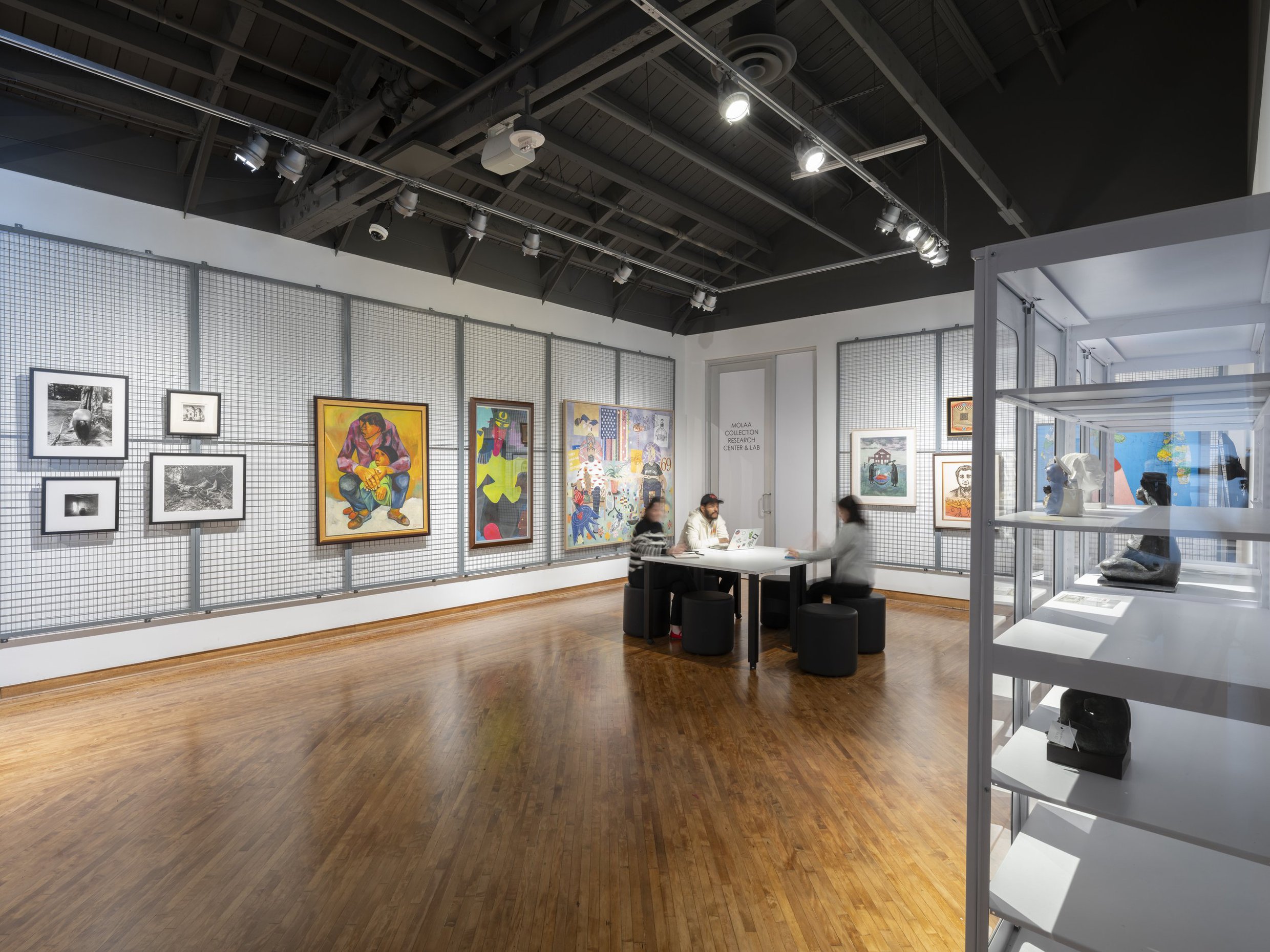
The primary result is to augment the Museum’s physical and digital artwork records for internal use as well as in a new public-facing online platform through MOLAA’s Open Laboratory & Research Center. The Center is located in the MOLAA galleries and houses the collections digitization project while supporting community-building efforts through academic and laboratory tours and giving the public a behind-the-scenes look at our process. In addition to MOLAA, the LMRFC counts four institutions of higher learning as project partners, including the University of California, Irvine, California State University Long Beach, University of California, Los Angeles and the University of Southern California.
The core museum activities this project applies to are collection, research, conservation, and multilingual (Spanish/English) education.
Explain in one sentence why you think the project you nominate is outstanding and could serve as an example for the entire community of modern and contemporary art museums.
This project, designed from an interdisciplinary and inclusive perspective, is a replicable model for other institutions due to its innovative academic and artistic collaboration approach, as its value lies in creating an open and diverse space that fosters joint work between students, curators, academics, and communities, thereby strengthening the connection between museums and society, while offering a concrete platform for professional development by creating new forms of participation in cultural spaces, such as museums, especially for BIPOC young people who have traditionally lacked access to these types of employment opportunities.
Explain why this practice or program is relevant and sustainable in creating meaningful and lasting connections with people, communities, and the museum context with a medium to long-term vision.
The LMRFC and the MOLAA Collection Research Center and Laboratory foster greater access to its exhibitions, collections, and educational programming to expand the Museum’s reach and impact. This approach strengthens the Museum's reputation and leadership role among local and global communities to foster new ideas and partnerships and drive innovation in the arts, invest in digital initiatives to increase reach and accessibility to a global audience, and prioritize diversity, equity, and inclusion in collections, exhibitions, programming, and staffing.
MOLAA uses the LMRFC to assist with two long-standing efforts: digitizing its collection and expanding the Museum’s research capacity for its collection, exhibitions, and programming. Digitizing the MOLAA Collection meticulously and impactfully will provide a platform that will expand our audience's reach and be a fundamental academic, curatorial, and educational resource.
What are the outcomes of the practice you are most proud of?
Developed cross-institutional relationships between four institutions of higher learning, forming the LMRFC, including the University of California, Los Angeles, the University of California, Irvine, California State University, Long Beach, and University of Southern California.
Conceived/created the Collections Research Center and Laboratory in the MOLAA galleries, which supports the collections digitization project and community-building efforts.
Placed two fellows in 2025, who gained museum, curatorial, research, cataloging, and digitization experience, developed presentation skills, and engaged in professional development opportunities.
Created a manual of procedures of the Collections Research Center and Laboratory, serving as a model for medium-sized museums and arts/cultural organizations for research and fellowship consortia.
Since September 2024, MOLAA has digitized 30% of its 1,300-object collection, expanding the museum's research and exhibition capacity. It presents bilingual (English/Spanish) research material to disseminate the rich culture of Latin America and its diaspora in the US and abroad and promote emerging, mid-career, and well-known artists.
How has the nominated practice changed your methods and ways of working?
The practices of the LMRFC and the MOLAA Collection Research Center and Laboratory have significantly contributed to the evolution of MOLAA’s staff approach to research through continuous networking within the museum field and academic collaborations. This has allowed for a broadening of perspectives, integrating diverse methodologies, and engaging effectively with both specialized and general audiences.
At the same time, it has allowed for mentorship to support new generations of curators, researchers, and cultural practitioners as they navigate and contribute to the field.