Moderna Museet
Moderna Museet is one of Europe’s leading museums for modern and contemporary art. We collect, preserve, share and exhibit modern art from the early 20th century and photography from 1840 and onwards.
The museum opened in 1958, when was moved from the Nationalmuseum into a former navy drill hall on Skeppsholmen in Stockholm.
Name of the practice nominated: Vaginal Davis: Magnificent Product
Describe the practice, program, or project, what innovative approach is proposed, and in which core museum activities it applies: conservation, education, collection, exhibition programs, publications, research, accessibility, communication, governance, and sustainability.
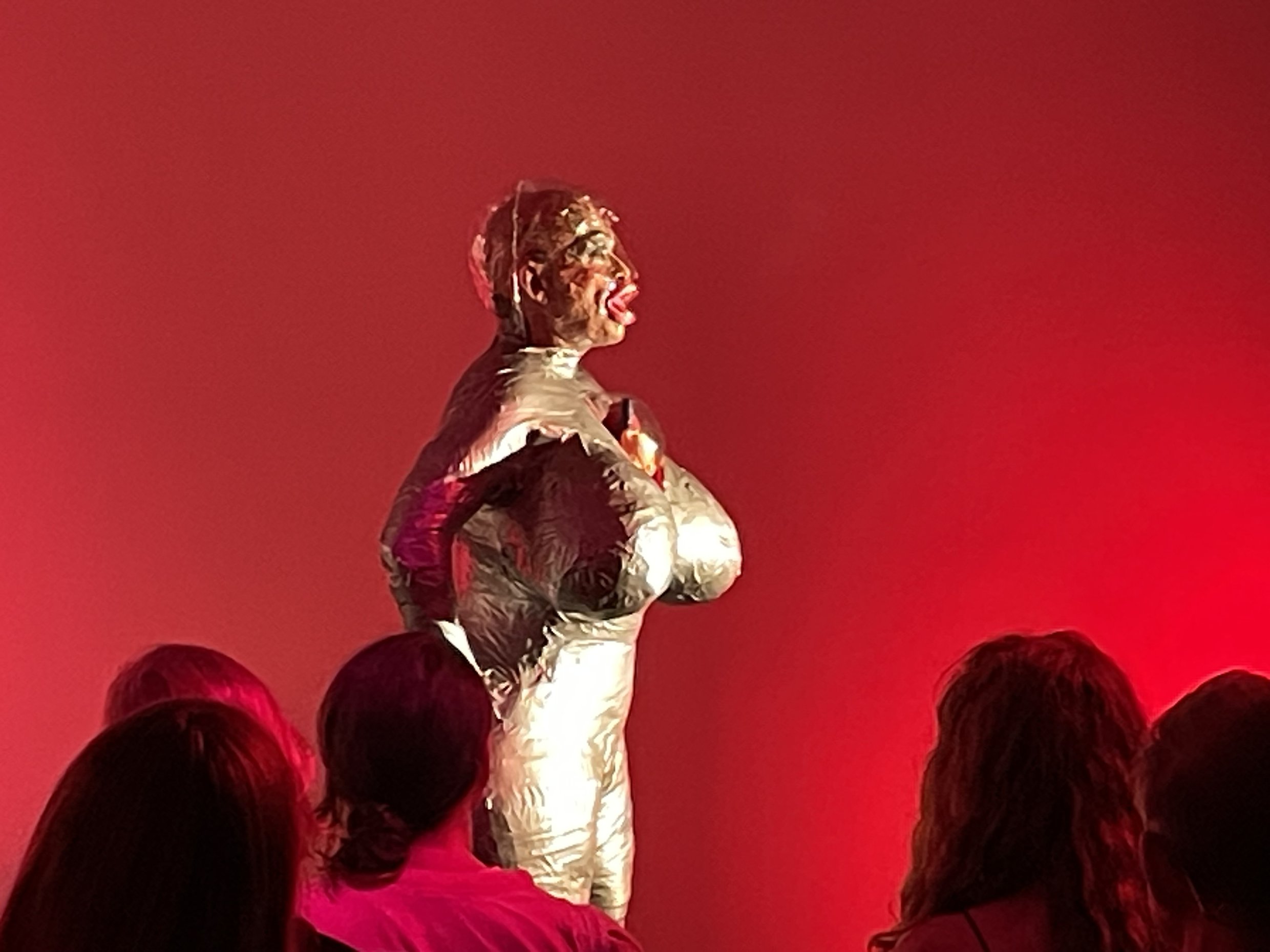
"Vaginal Davis: Magnificent Product" took the practice of punk queer icon Vaginal Davis to create a project across multiple venues in Stockholm. Each partner hosted a different part of Vaginal Davis’s practice, aligned with that institution’s expertise:
- Moderna Museet: an exhibition of Vaginal Davis’s practice from the late 1970s onward
- Nationalmuseum: a new installation in the museum’s library, alongside a display of Vaginal Davis’s paintings in the galleries of the Nationalmuseum
- Index – Swedish Foundation for Contemporary Art: a library of Vaginal Davis’s writing from the 1980s onward, activated through extensive programming including a summer school with the Royal Art Academy in Stockholm
- Accelerator Konsthall: a performance project on CHEAP Collective, which Vaginal Davis has been part of since the early 2000s
- Moderna Dansteatern (MDT): a series of annotated film screenings, curated by Vaginal Davis
- Tensta konsthall: a weekend-long marathon event, featuring lectures, performances, readings, exercises and communal spaces, highlighting Vaginal Davis’s work as an educator as well as Stockholm queer scenes
- Cinema Queer: an installation and film screenings featuring Vaginal Davis’s pioneering moving image practice
The project aimed to create a more kaleidoscopic view of Vaginal Davis’s practice, while creating spaces of collaboration across all the museum’s responsibilities, from exhibitions and education, to programming, conservation, communication, and publications. This was both a pragmatic and a political choice. Queerness is not a uniform thing, it is fragmented, multitudinous, and by nature, resists singular narration. The project needed to reflect that multiplicity, especially at a moment when queer history is being written, revised, and written again in a landscape of continuing culture wars. The collaborative impulse was informed by both an insistence on multiplicity that aligns with the practice of Vaginal Davis and a desire to host communities in different ways and in different spaces.
Explain in one sentence why you think the project you nominate is outstanding and could serve as an example for the entire community of modern and contemporary art museums.
The project created a different type of institutional space--interstitial, embracing fragmentation and decentralisation, arguably queer--in which each partnering institution formed their own perspective on Vaginal Davis's pioneering practice, ultimately also creating a radically different viewers' experience founded on fracture rather than coherence.
Explain why this practice or program is relevant and sustainable in creating meaningful and lasting connections with people, communities, and the museum context with a medium to long-term vision.
With “Vaginal Davis: Magnificent Product,” Moderna Museet created an infrastructure between the partner institutions in Stockholm, which allowed for a sharing of research, resources, and audiences. This was recognized by the communities that the project engaged with, creating a flow across the venues. This infrastructure is built to last, as it leads to more forms of collaboration and dialogue for future projects. But perhaps more importantly, with Moderna Museet being the largest modern and contemporary art museum in Sweden, it shows the POSSIBILITY of doing something like this, a psychological shift brought on by museum engaging sister institutions and communities in this manner.
What are the outcomes of the practice you are most proud of?
“Vaginal Davis: Magnificent Product” adopted the outlook of each host. In other words, rather than Moderna Museet curating each specific project in the respective partner institution, the partner institution brought their own expertise to the project, ultimately creating presentations on Vaginal Davis’s practice with different emphases and sensibilities. This required careful dialogue on the part of the organizer (Moderna Museet), trying to understand what each partner could bring out in Vaginal Davis’s work.
The outcome of this, among many things, is a mode of curatorial and museological practice that is deeply rooted in dialogue, collaboration, and continuing exchange.
How has the nominated practice changed your methods and ways of working? (Max 150 words)
The project has reinforced the museum’s commitment to an artist-centered approach, championing that each project, whether it be an exhibition, a publication, an acquisition, or any other presentation, follows the philosophy of radical hospitality: the labor and conditions of the museum adapt to artistic practice rather than the other way around. For Vaginal Davis, this necessitated a decentralized, queer perspective on curatorial practice, resulting in the exhibitions, performances, educational and public programs, publication, and a major acquisition that made up the “magnificent product,” hosted not by a single institution, but by an entire city.
https://www.modernamuseet.se/stockholm/en/ exhibitions/vaginal-davis/