Practical Information for CIMAM Delegates in Turin
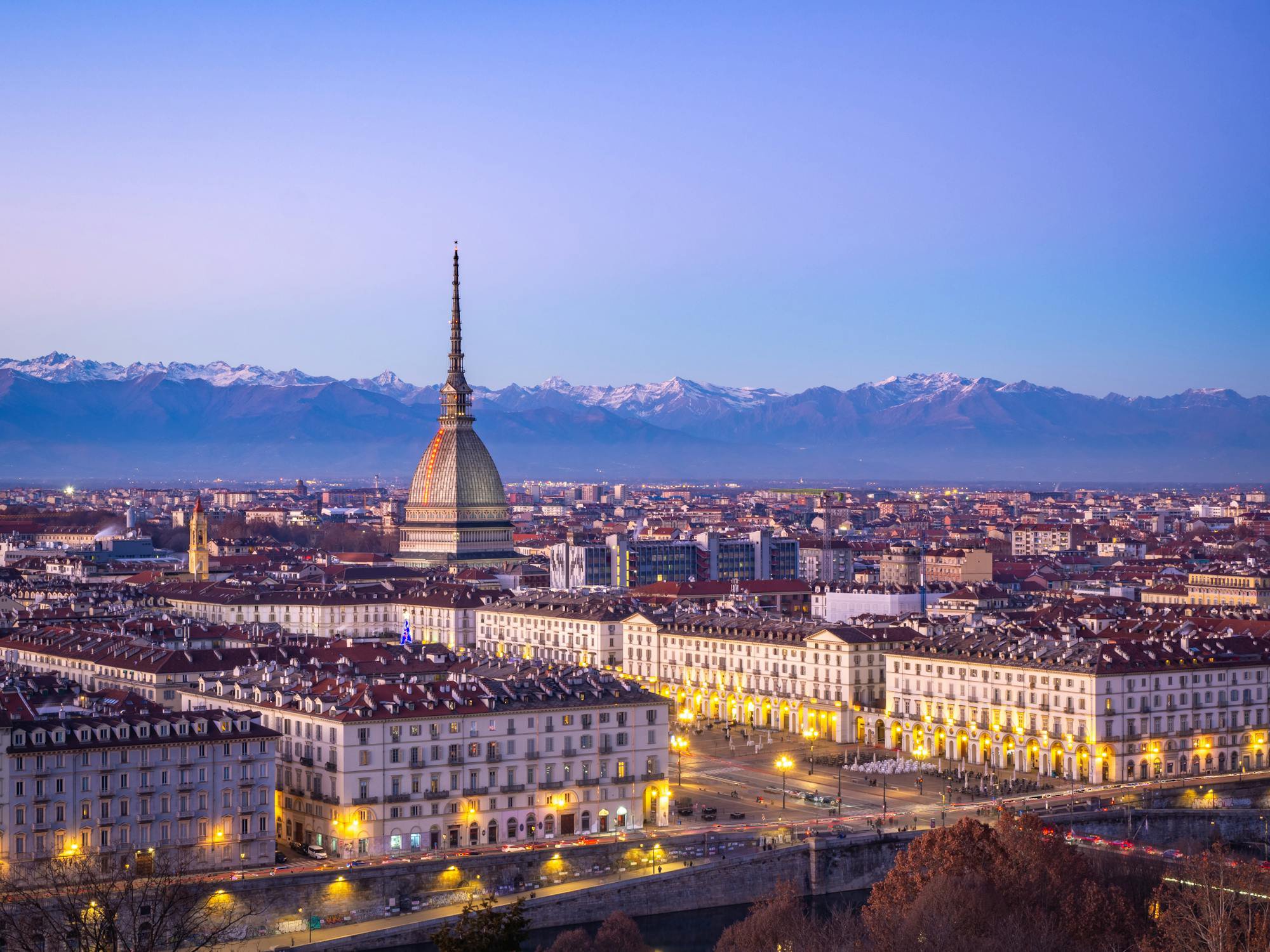
Table of Contents:
- Arrival & Airport
- Hotel Pick-ups & Drop-offs
- Getting Around the City
- Useful Local Information
- Emergency Contacts
- Getting Started: Registration and Program Access
- Badge Collection
- Conference Program
- Virtual Who's Who
- Sustainability Guidelines
- Landmarks & Cultural Highlights
Arrival & Airport
Turin’s main airport, Turin–Caselle Airport (TRN), is located 15–20 km northwest of the city centre.
- Transport to the city: Regular bus and train connections link the airport to Porta Susa and Porta Nuova stations (approx. 45 minutes).
- Taxi: Taxis are available outside the terminal (average fare €30–35 to the centre).
- Tip: If arriving late at night or very early, check bus/train schedules in advance, as night services are limited.
Visit: torino.in
Hotel Pick-ups & Drop-offs
Below you will find the exact pick-up point for each hotel. Conference staff will also be present at all hotels to guide you to the buses.
- Hotel Plaza: 100 m – Via Nizza 123 bus stop
- Hotel Concord: 90 m – C.so Vittorio Emanuele II 54 (in front of Starhotels Majestic)
- Hotels Sitea, Victoria & NH Collection Piazza Carlina: pick-up/drop-off in front of NH Collection Piazza Carlina (Piazza Carlo Emanuele II)
- Grand Hotel Sitea: 8-min walk (600 m)
- Hotel Victoria: 5-min walk (500 m)
- NH Santo Stefano & COMBO Torino: opposite COMBO, Via XX Settembre at the corner of Corso Regina Margherita
- Hotel COMBO: 100 m walk
- NH Santo Stefano: 3-min walk (300 m)
Getting Around the City
Turin has a reliable network of buses, trams, and a metro line, all operated by GTT (Gruppo Torinese Trasporti). turinitalyguide.com
- Tickets must be purchased before boarding (newsstands, vending machines, tobacconists, or via the bilingual TO Move App). en.unito.it
- Single ticket: valid 100 minutes on any transport. gtt.to.it
- Day pass: unlimited travel for 24 hours. gtt.to.it
- Night buses: operate on Fridays, Saturdays, and pre-holidays (“Night Buster” service).
- Tip: Validate your ticket when boarding and consider a day pass if you plan to explore outside conference hours. turismotorino.org
We recommend walking when possible.
Useful Local Information
- Time zone: Central European Time (CET), UTC +1
- Language: Italian (English widely spoken in museums, hotels, and restaurants)
- Currency: Euro (€) Most hotels, restaurants and museums accept cards, but it’s worth carrying some cash for smaller cafés or local retailers.
- Weather (late November): 5–10°C, cool and possibly rainy. Pack a warm layer and a light waterproof jacket.
Emergency Contacts
- General emergency (police / fire / ambulance): 112 (EU-wide)
- Taxi service: +39 011 5730 / +39 011 5737
(or use the bilingual Wetaxi app) - Conference helpdesk: contact details will be shared at registration
- Hotel reception: keep your hotel’s contact number handy
Getting Started: Registration and Program Access
Access control will be in place at the conference venues, lunch and dinners, and throughout the program. Therefore, it is essential that all registered participants wear their badges at all times.
Badge Collection: Registration will be open at Hotel Concord on Thursday, 27 November, from 9:30 am to 6:30 pm.
You may also collect your badge each morning at the respective conference venue.
- Friday 28 November
Venue: OGR Torino, Corso Castelfidardo, 22, Torino - Saturday 29 November
Venue: Carignano Theatre, Piazza Carignano 6, Torino - Sunday 30 November
Venue: Centrale Nuvola Lavazza, Via Bologna 32, 10152 Torino
Transportation will be arranged every morning from CIMAM recommended Hotels to the three conference venues.
Conference Program: Review the full day-by-day Conference Program here, where each speaker’s abstract and biography are linked, as well as each venue’s address and visit details.
Who's who: For the first time, CIMAM is offering a virtual Who's Who for you to browse and meet CIMAM conference attendees. The page is password-protected.
Please note that no printed program will be distributed. Instead, you can access all event information via the QR code printed on your badge, which links directly to daily schedules and venues, speaker bios and abstracts, and afternoon visits and locations.
Sustainability Guidelines
CIMAM is committed to reducing the environmental footprint of its Annual Conference.
We kindly invite all delegates to:
- Bring your reusable water bottle: refill stations will be available at all venues.
- Travel responsibly: The conference organization will provide shuttle buses connecting the recommended hotels with the venues for each day’s program.
When traveling independently, we encourage you to walk whenever possible, or use public transport or shared taxis to reduce emissions.
Materials and Resource Efficiency
CIMAM has greatly reduced printed materials, single-use items, and conference gifts.
This year’s essential items include:
- Conference Bag: Nature Fairtrade certified, natural cotton, unbleached, printed locally in Turin with natural dyes.
- Name Badges: Made from Environmentally Friendly ECF boards, FSC® certified, recyclable, and biodegradable.
- Lanyards: Produced from R-PET (100% recycled polyester) without dyeing. Saving up to 75% energy and cutting CO₂ emissions compared to virgin PET.
- Clipboards: Made from MDF (Medium Density Fibreboard) using reclaimed wood from processing waste and offcuts.
All these materials - except for the badges and lanyards, which serve as identification during the event - are optional to use.
Collection and Reuse
At the end of the conference (Day 3), participants are invited to return their materials at designated collection points. Items will be reused or recycled for future CIMAM events. Event staff will guide you to the appropriate collection stations.
Digital Program
To avoid paper waste, no printed program will be produced. Instead, a QR code on your badge links directly to the full online program, including:
- Daily schedules and venues
- Speaker bios and abstracts
- Information on afternoon visits and locations
Please use the QR code and join the CIMAM2025 WhatsApp group for real-time updates and practical information throughout the event.
Landmarks & Cultural Highlights
Turin (Torino), the capital of the Piedmont region in north-west Italy, possesses a history that exemplifies the intersection of political power, urban design, and cultural production in European modernity.
Originally founded as the Roman military settlement Augusta Taurinorum in the first century BCE, the city’s orthogonal street plan still reflects its ancient origins. Following periods of Lombard and Frankish control, Turin emerged in the Middle Ages as a fortified town of growing regional significance.
From the sixteenth century onwards, the city’s trajectory became inseparable from that of the House of Savoy, which consolidated its ducal power and established Turin as the administrative and cultural capital of its territories. Under Savoy patronage, Turin underwent extensive urban transformation, becoming a laboratory for Baroque planning and architecture. Figures such as Guarino Guarini and Filippo Juvarra endowed the city with monumental churches, palaces and public spaces that articulated dynastic authority through architectural grandeur.
In the nineteenth century, Turin assumed a central role in the Risorgimento - the movement for Italian unification - serving as the first capital of the Kingdom of Italy from 1861 to 1865. This period marked the beginning of its industrial and intellectual ascendancy, reinforced in the early twentieth century by the growth of the automobile industry, which transformed Turin into a symbol of Italian industrial modernity.
Today, Turin reflects the layered history of its Baroque and industrial past while standing as a leading centre for contemporary culture in Italy. Its thriving art scene occupies many of the city’s restored industrial buildings, where former factories and workshops have been reimagined as museums, foundations and exhibition spaces. These spaces, alongside Turin’s broader network of public and independent cultural institutions, demonstrate how the city’s industrial heritage continues to shape its cultural identity and its ongoing commitment to creativity, dialogue and renewal.
Mole Antonelliana
The city’s most recognisable landmark, originally conceived as a synagogue and now home to the National Museum of Cinema. Its distinctive spire dominates the skyline and offers panoramic views over the city and the Alps.
Piazza Castello
The historic heart of Turin, framed by royal and civic architecture. Here you’ll find Palazzo Madama and Palazzo Reale, testaments to the city’s Baroque grandeur and its centuries as a Savoy capital.
Palazzo Reale (Royal Palace)
Once the residence of the House of Savoy, this UNESCO World Heritage Site reflects the political and artistic ambitions of Turin’s ruling dynasty. Its interiors and adjoining gardens remain among the city’s most elegant spaces.
Via Roma & Piazza San Carlo
Via Roma, with its arcades and symmetry, links Piazza Castello to Piazza San Carlo — often called “Turin’s drawing room.” The latter is known for its twin Baroque churches and historic cafés.
Cathedral of San Giovanni Battista & The Chapel of the Holy Shroud
The city’s cathedral houses the Chapel of the Holy Shroud, a masterpiece of Baroque architecture by Guarini. Though the relic itself is rarely displayed, the site remains deeply symbolic in Turin’s cultural identity.
Among Turin’s many historic cafes are Caffè San Carlo, Caffè Torino, Caffè Fiorio, Al Bicerin, and Baratti & Milano. These are long-standing meeting places that reflect the city’s social and cultural life.
Recommended Turin Restaurants and Cafes
- Ristorante Al Gatto Nero – A legendary Turin dining-room since 1927, known for old-school elegance and a deep wine cellar.
Website: gattonero.it
Address: Corso Filippo Turati 14, 10128 Torino.
Map: Google Maps – Al Gatto Nero - Scannabue Caffè Restaurant – In San Salvario, a refined yet accessible spot blending tradition and creativity in Piedmontese cuisine.
Website: scannabue.it
Address: Largo Saluzzo 25/H, 10125 Torino.
Map: Google Maps – Scannabue - Ristorante Consorzio – Minimalist atmosphere serving some of the city’s most interesting takes on Piedmontese classics with a standout natural-wine list.
Website: ristoranteconsorzio.it
Address: Via Monte di Pietà 23, 10122 Torino.
Map: Google Maps – Ristorante Consorzio - Le Tre Galline – A venerable table (with roots spanning ~500 years) offering seasonal ingredients and reinterpretations of Turin’s gastronomic memory.
Website: 3galline.it
Address: Via Bellezia 37, 10122 Torino.
Map: Google Maps – Le Tre Galline - I Tre Galli – Vineria Ristorante – A wine-centric bistro in the city centre, celebrated for its 1,200+ label wine list and relaxed vibe.
Website: 3galli.com
Address: Via Sant’Agostino 25, 10122 Torino.
Map: Google Maps – I Tre Galli - Le Vitel Étonné – A playful name and refined kitchen focusing on regional specialities (notably vitello tonnato) and elegant service.
Website: leviteletonne.com
Address: Via S. Francesco da Paola 4, 10123 Torino.
Map: Google Maps – Le Vitel Étonné - Il Cambio (Ristorante Del Cambio) – One of Turin’s grande dames of dining (est. 1757), marrying historic ambiance with creative cuisine and a storied heritage.
Website: delcambio.it
Address: Piazza Carignano 2, 10123 Torino.
Map: Google Maps – Ristorante Del Cambio - Pastis – Set in the Quadrilatero Romano, part café/part bar/part restaurant—an artsy hang-out serving Mediterranean and home-style dishes amid creative energy.
Website: pastistorino.com
Address: Piazza Emanuele Filiberto 9/B, 10122 Torino.
Map: Google Maps – Pastis - Caffè al Bicerin dal 1763 – A historic café where the iconic “bicerin” drink (espresso + chocolate + cream) originates; a must for a classic Turin experience.
Website: bicerin.it
Address: Piazza della Consolata 5, 10122 Torino.
Map: Google Maps – Caffè al Bicerin - Gelateria Pepino 1884 – A historic café and gelateria in Piazza Carignano (founded in 1884) famous for its iconic ice-cream “Pinguino” and elegant historic-salon ambience.
Some Regional Dishes and Desserts
- Vitello tonnato – Thin slices of chilled veal served with a creamy tuna-and-capers sauce, one of Piedmont’s most iconic antipasti.
- Agnolotti del plin – Small, hand-pinched pasta parcels (“plin” means “pinch”) traditionally filled with roasted meats and served with butter or meat juices.
- Bollito – A comforting selection of slow-boiled meats served with classic sauces such as salsa verde, bagnet rosso and mostarda.
- Bagna cauda – A warm, savoury anchovy–garlic–olive oil dip served with raw and cooked vegetables for communal sharing.
- Giardiniera – A colourful mix of vegetables pickled in vinegar, offering a tangy, crunchy accompaniment to meats and antipasti.
- Bunet (Bonèt) – A rich chocolate-and-amaretto baked pudding, silky like a flan and beloved across the region.
Truffle season in Piedmont - White truffles grow naturally in the forests of Piedmont, especially around Alba, and are celebrated for their intense aroma and rarity. They can’t be cultivated - only foraged - which is part of why they’re so special. Autumn in the Turin region coincides with truffle season, when restaurants showcase the prized white truffle shaved over pasta, eggs, risotto or delicate meat dishes. Some of the restaurants listed will feature seasonal truffle dishes during this period, offering visitors the chance to experience one of Piedmont’s most celebrated and aromatic culinary traditions.